Growth is exciting until everyday operations start slowing you down. Orders pile up, reports take days, inventory numbers don’t match, and teams rely on disconnected spreadsheets. If this sounds familiar, your business may have reached the point where Odoo integration is no longer optional but necessary.
Modern ERP platforms don’t just store data, they automate workflows, provide real-time visibility, and connect departments into a single system. They also use built-in intelligence, including automation rules, predictive insights, and contextual recommendations to trigger actions across teams and surface issues proactively. When operations run on unified software, leaders gain clarity, employees spend less time on manual work, and customers experience faster, more reliable service.
Unlike traditional setups that rely on multiple separate applications, modern all-in-one platforms combine CRM, sales, accounting, inventory, HR, and operations in a single environment that scales as the business grows.
This guide will help you determine whether your organization has outgrown manual processes and what practical steps to take next.
Quick Checklist: Signs You May Need Odoo Integration
If you answer “yes” to several of these, your business is likely ready for an integrated ERP system:
- Data lives in multiple disconnected tools
- Reports take hours or days to compile
- Inventory inaccuracies are increasing
- Teams duplicate data entry
- Decisions rely on outdated information
- Growth requires hiring more administrative staff
- Leadership lacks real-time visibility
- Teams rely on many software tools that don’t communicate
- Maintaining integrations between systems is costly or unreliable
Key Takeaways
- Manual processes limit scalability and decision speed
- Disconnected tools create data silos and errors
- Real-time visibility is essential for modern operations
- Integrated ERP systems unify business functions
- Odoo is designed to support growing mid-market organizations
Why Growing Companies Outgrow Manual Processes
In the early stages, simple tools work well. Founders manage sales in spreadsheets, accounting in separate software, and operations manually. But as transaction volume increases, complexity grows faster than teams can handle.
Manual systems create hidden operational costs:
- Time lost on repetitive tasks
- Errors from duplicate data entry
- Delayed decisions due to outdated reports
- Limited visibility across departments
- Difficulty scaling operations efficiently
Hiring more staff rarely solves these issues. Without business process automation and a unified system, complexity compounds instead of shrinking.
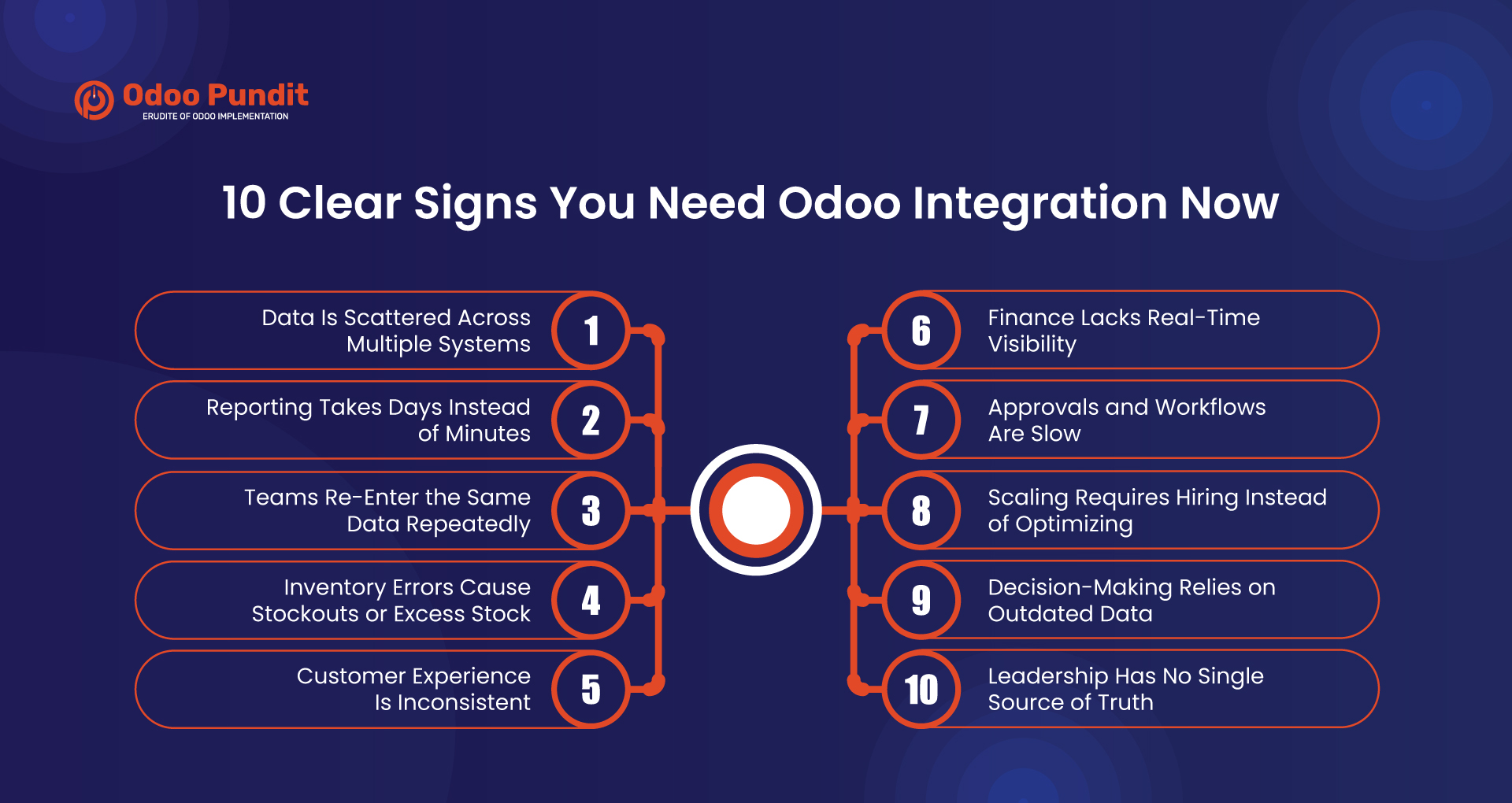
10 Clear Signs You Need Odoo Integration Now
1. Data Is Scattered Across Multiple Systems
Sales, finance, inventory, and operations operate in silos. Teams export files, reconcile spreadsheets, and manually sync data.
An integrated ERP creates a single source of truth where updates appear instantly across departments, eliminating inconsistencies and confusion.
2. Reporting Takes Days Instead of Minutes
If monthly reporting requires collecting files from multiple teams, leadership decisions will always lag behind reality.
Modern dashboards provide real-time reporting with forward-looking metrics and drill-down visibility into underlying transactions. Leaders can monitor performance across sales, finance, operations, and inventory in one place, without assembling separate reports.
3. Teams Re-Enter the Same Data Repeatedly
Customer information entered in CRM must be retyped in accounting or inventory tools. This duplication wastes time and introduces errors.
Integrated workflows capture data once and reuse it across processes, improving accuracy and productivity.
4. Inventory Errors Cause Stockouts or Excess Stock
Manual tracking struggles to keep up with demand fluctuations. Businesses either run out of products unexpectedly or tie up capital in excess inventory.
Advanced inventory management tools provide real-time stock visibility, demand forecasting, automated replenishment, and support for multiple warehouses. Predictive rules can suggest procurement or production actions before shortages occur.
Detailed tracking also supports lot and serial number traceability, critical for quality control and compliance in many industries.
5. Customer Experience Is Inconsistent
Customers receive conflicting information from different departments. Sales promises timelines operations cannot meet, or support lacks order history.
A unified system gives teams access to the same customer data across sales, marketing, service, and commerce channels, supporting consistent experiences across every interaction.
6. Finance Lacks Real-Time Visibility
If financial insights arrive weeks after transactions occur, leadership cannot make timely decisions.
Integrated accounting provides live cash flow visibility, automated invoicing, expense tracking, reconciliation, and audit trails. Multi-company and multi-currency capabilities also support expanding organizations managing complex structures.
7. Approvals and Workflows Are Slow
Requests move through emails or chat threads, causing delays and missed approvals.
Digital workflows route tasks automatically based on roles and rules. Actions in one department can trigger processes in others, creating seamless end-to-end operations. Exception handling ensures unusual situations are flagged instead of overlooked.
8. Scaling Requires Hiring Instead of Optimizing
If growth always requires more administrative staff, operations are not scalable.
Automation enables teams to handle higher volumes without proportional increases in headcount, improving efficiency and profitability.
9. Decision-Making Relies on Outdated Data
Leaders relying on weekly or monthly reports are essentially driving while looking in the rear-view mirror.
Real-time analytics and performance dashboards enable faster, data-driven decisions based on current conditions.
10. Leadership Has No Single Source of Truth
Different departments report different numbers, leading to confusion and slow decision-making.
Centralized data ensures everyone works from consistent information, aligning strategy and execution.
How Integrated Systems Solve These Problems
A modern ERP platform connects core functions, CRM, sales, inventory, accounting, HR, and service within one environment.
For example, when a sales order is confirmed:
- Inventory updates automatically
- Procurement or production triggers if needed
- Invoice generation begins
- Financial records update instantly
- Customer history reflects the transaction
This connected flow eliminates manual handoffs and delays. Automated alerts help teams address issues before they escalate.
Organizations exploring Odoo integration services often start by connecting existing tools, then gradually consolidate operations into a unified platform. This phased approach minimizes disruption while delivering early efficiency gains.
Shared data improves collaboration because teams work from the same information instead of relying on manual updates.
Is Your Business Ready for Odoo Integration?
Not every organization needs ERP immediately. However, these indicators suggest readiness:
- Rapid growth in customers or transactions
- Multiple departments requiring coordination
- Increasing compliance requirements
- Heavy reliance on disconnected software
- Difficulty maintaining data accuracy
- Need to standardize processes across locations
- Leadership seeking real-time insights
If several apply, delaying system improvements may limit future growth.
What Happens If You Delay ERP Adoption?
Postponing operational upgrades creates compounding risks:
Rising Costs: Manual work consumes time and labor
Lost Opportunities: Slow processes limit responsiveness
Competitive Disadvantage: More efficient competitors move faster
Employee Burnout: Staff focus on repetitive tasks instead of strategic work
Eventually, change becomes urgent rather than planned.
What to Expect During an Odoo Integration Project
Successful ERP projects follow a structured approach:
- Assess current workflows and bottlenecks
- Configure the system to match business processes
- Migrate historical data
- Test workflows and validate accuracy
- Train users and align processes
- Launch and optimize continuously
Many companies begin with core areas such as CRM, sales, inventory, and finance, then expand gradually.
Working with experienced partners for Odoo implementation reduces risks and accelerates results. Some organizations initially integrate Odoo with existing systems before replacing fragmented tools entirely.
How to Evaluate Whether Odoo Is the Right ERP for You
Consider these factors:
- Operational complexity
- Number of disconnected systems
- Need for real-time reporting
- Scalability requirements
- Budget and internal readiness
- Long-term maintenance considerations
Odoo supports a wide range of industries, including manufacturing, distribution, retail, services, and project-based businesses.
What to Do Next If These Signs Apply
If your organization recognizes several of these challenges:
- Map current systems and workflows
- Identify major bottlenecks
- Estimate time spent on manual tasks
- Define scalability goals
- Consult an ERP specialist for an objective assessment
Taking these steps helps ensure any transformation is strategic rather than reactive.
Conclusion: Growth Should Enable Efficiency, Not Chaos
Every successful company eventually reaches a point where informal tools stop working. What once enabled agility begins to limit progress. Recognizing this transition early allows leaders to modernize operations before inefficiencies undermine performance.
If several signs in this guide resonate with your situation, your organization may be ready for a more connected approach to managing operations. Integrated systems bring clarity, improve productivity, and support sustainable growth without overwhelming teams.
Not sure where to begin?
A structured process review can reveal gaps, identify quick wins, and outline a practical path toward scalable operations, helping you move forward with confidence.
FAQs
Odoo integration connects business processes and systems into a unified platform, while full implementation replaces fragmented tools with a comprehensive ERP environment.
When manual processes slow operations, data becomes fragmented, or growth creates coordination challenges across departments.
Yes. Its modular structure allows companies to start with essential capabilities and expand as needs evolve.
If spreadsheets cause errors, delays, limited visibility, or excessive manual work, integrated systems are typically needed to scale effectively.
Basic deployments may take weeks, while organization-wide implementations can take several months depending on complexity.
Odoo can be deployed in the cloud, on dedicated infrastructure, or on-premise depending on business requirements.