As companies grow, financial processes often become scattered across tools, teams, and spreadsheets. Invoices may live in one system, expenses in another, and cash flow visibility depends on manual reconciliation. This fragmentation slows decision-making and increases the risk of errors just when financial clarity matters most.
Odoo accounting software addresses this challenge by bringing invoicing, expenses, banking, reporting, and compliance into a single platform connected to everyday business operations. Because accounting entries are generated from validated transactions, not manual bookkeeping, financial data stays aligned with what is actually happening in the business.
Recent versions also include AI-assisted capabilities such as document recognition, bill parsing, and reconciliation suggestions, helping finance teams reduce manual effort while maintaining control. For growing SMEs moving beyond basic accounting tools, this integrated approach can significantly improve visibility, accuracy, and scalability.
What Is Odoo Accounting Software?
Odoo accounting software is an ERP-integrated financial management system that automates invoicing, expenses, payments, reconciliation, and reporting by generating accounting entries directly from validated business transactions.
Because transactions originate from operational activities, such as sales, purchases, expenses, inventory movements, and payroll, financial reports remain continuously aligned with real business performance rather than relying on after-the-fact bookkeeping.
Key Takeaways
- Integrates accounting with sales, purchasing, inventory, HR, projects, and subscriptions
- Automates invoicing, expenses, reconciliation, and reporting workflows
- Provides real-time financial visibility for decision-makers
- Supports multi-company consolidation and multi-currency operations
- Includes AI-assisted document processing and reconciliation suggestions
- Scales with growing SMEs without requiring system replacement
- Delivers the best results with proper implementation and configuration
Why SMEs Are Moving Toward Automated Accounting Systems
Many organizations reconsider their accounting setup only when growth exposes inefficiencies manual processes can no longer support.
Hidden Costs of Manual Processes
Manual or semi-manual accounting creates problems that compound over time:
- Repeated data entry across departments
- Delayed billing that disrupts cash flow
- Spreadsheet errors that are difficult to detect
- Slow month-end closing
- Limited visibility into receivables and payables
Individually these issues seem manageable. Together, they reduce productivity and financial control.
Increasing Compliance Expectations
As companies expand, stakeholders expect structured reporting, auditability, and regulatory alignment.
Odoo provides localization packages and built-in tax engines that support VAT, GST, and regional reporting formats. However, organizations must configure these properly to meet specific legal requirements. In jurisdictions where supported, Odoo also enables electronic invoicing and digital document exchange, helping businesses adapt to modern tax reporting frameworks.
Need for Real-Time Financial Insight
Leadership teams increasingly rely on current financial data to make timely decisions.
Integrated accounting systems provide live visibility into revenue, expenses, liabilities, and cash positions, enabling faster responses to changing business conditions.
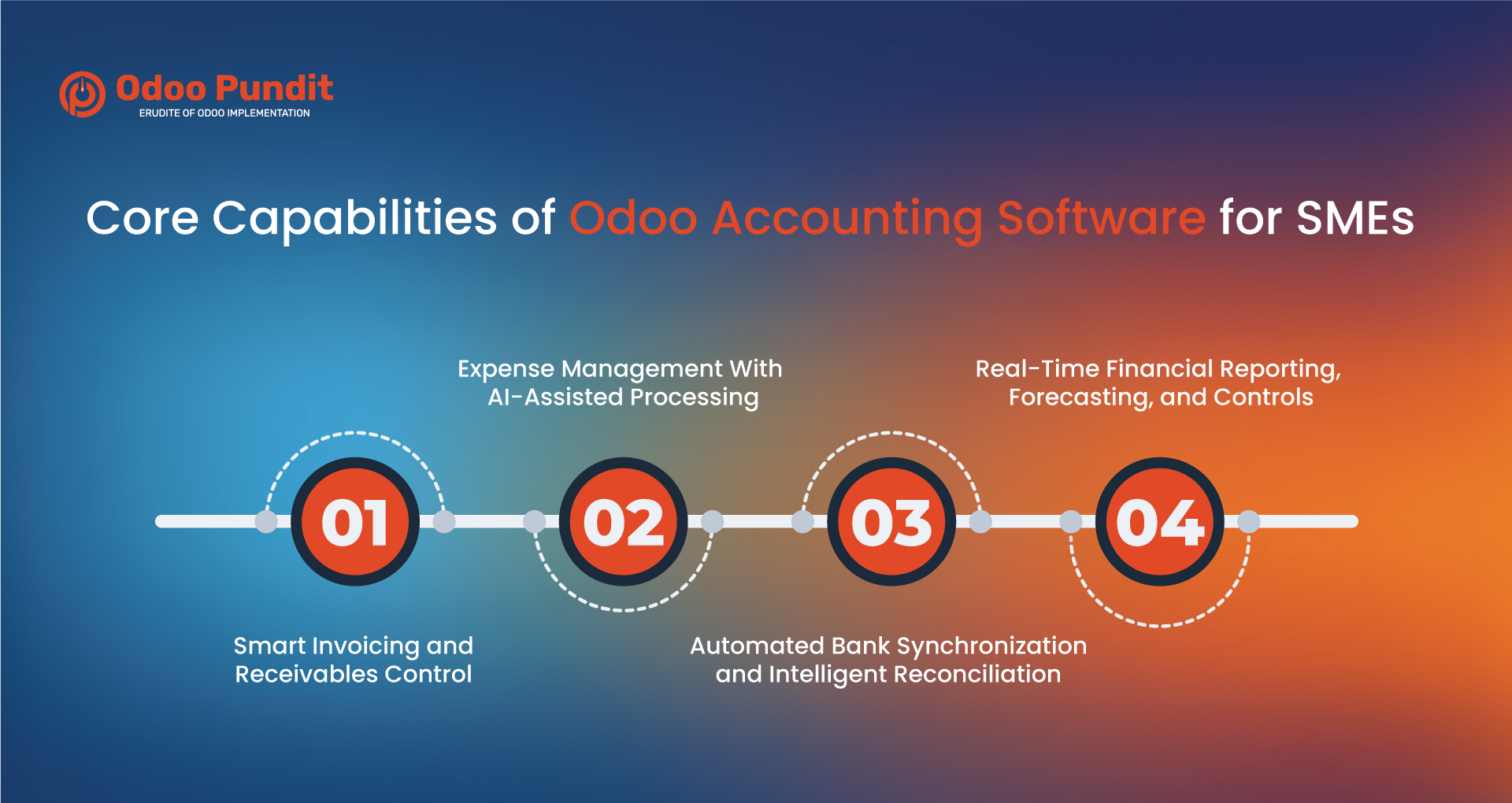
Core Capabilities of Odoo Accounting Software for SMEs
Smart Invoicing and Receivables Control
Effective receivables management directly impacts liquidity.
Odoo supports:
- Automatic invoice creation from sales transactions
- Recurring billing for subscriptions or service contracts
- Customer payment portals
- Credit limits and payment terms
- Automated payment reminders via email or messaging
- Aging analysis reports
- Credit notes linked to original invoices
- Multi-currency billing
- Integration with online payment providers
- Partial payments, advance payments, and allocation across invoices
These capabilities help shorten the order-to-cash cycle and reduce outstanding balances.
Expense Management With AI-Assisted Processing
Expense tracking becomes more complex as organizations grow.
Odoo provides structured workflows including:
- Digital expense submission
- Receipt scanning with OCR extraction
- AI-assisted data capture
- Corporate credit card synchronization
- Policy-based approval processes
- Automatic posting to accounting
- Reimbursement tracking
- Linking expenses to projects or departments via analytic accounts
These features improve transparency while minimizing manual entry.
Automated Bank Synchronization and Intelligent Reconciliation
Odoo imports bank transactions and suggests matches using reconciliation rules, historical patterns, and AI-assisted recommendations.
Reconciliation is validated by users to ensure accuracy. In some cases, predefined rules allow transactions to be reconciled automatically when matches are exact.
Key benefits include:
- Faster reconciliation cycles
- Reduced manual matching
- Immediate cash visibility
- Detection of anomalies
- Support for multiple bank accounts and currencies
Direct bank synchronization is available for supported institutions, while bank statement files can be imported manually when automated connections are not available.
Real-Time Financial Reporting, Forecasting, and Controls
Because accounting entries are generated as transactions occur, reports remain continuously updated.
Standard outputs include:
- Profit and loss statement
- Balance sheet
- General ledger
- Aged receivables and payables
- Tax reports
- Cash flow insights
- Budget tracking
- Consolidated multi-company reporting
Reports can be generated on either accrual or cash basis. Financial dashboards may also include forecasts based on real-time data.
Lock dates prevent changes to closed periods, and audit trails link entries to their originating documents. Analytic accounting enables profitability tracking by project, department, product line, or activity.
Fiscal positions allow automated tax and account mapping for different jurisdictions, customer types, or transaction scenarios.
How Odoo Automates the Entire Accounting Workflow
Automation delivers the greatest value when applied across end-to-end processes.
Quote-to-Cash (Sales to Payment)
- Sales order confirmed
- Invoice generated automatically
- Invoice delivered electronically
- Customer payment recorded
- Journal entries posted
- Reports updated in real time
Subscription-based businesses can automate recurring invoices and payments for predictable revenue streams.
Procure-to-Pay (Purchasing to Vendor Payment)
- Purchase order issued
- Goods or services received
- Vendor bill created or imported
- Payment scheduled
- Accounting entries posted
AI-assisted bill parsing extracts supplier details, line items, and taxes, reducing manual processing.
Integration With Operational Data
When modules are connected, accounting reflects operational activity:
- Inventory movements generate entries under perpetual valuation methods
- Periodic inventory requires manual adjustments at period end
- Project costs feed profitability analysis
- Payroll expenses post to financial statements
- Fixed assets are tracked with automated depreciation schedules
Organizations adopting ERP-wide transformation often align finance processes through a structured Odoo implementation.
Benefits of Odoo Accounting Software for SME Growth
Reduced Manual Work with Strong Controls
Automation eliminates repetitive tasks while maintaining auditability.
Improved Cash Flow Management
Faster invoicing and payment tracking improve liquidity planning.
Better Decision Support
Real-time financial data enables proactive management rather than reactive reporting.
Scalability Without Platform Replacement
The system supports growth across entities, currencies, and reporting complexity.
Lower Operational Fragmentation
A single platform replaces multiple disconnected tools and manual reconciliations.
How Odoo Differs from Traditional Accounting Software
Traditional systems treat accounting as a separate function. Odoo treats it as the financial outcome of business operations.
Because entries originate from real transactions:
- Data consistency improves across departments
- Financial results are traceable to operational activity
- Manual reconciliation decreases
- Reporting becomes more timely
Manual journal entries remain available for adjustments and complex scenarios. Analytic accounting provides deeper profitability insights beyond standard reports.
Odoo vs Standalone Accounting Tools: When ERP Accounting Makes Sense
Standalone accounting software works well for basic bookkeeping but often lacks integration with operational systems.
An ERP-based approach synchronizes financial and operational information automatically, improving accuracy and coordination. Organizations with unique workflows sometimes explore Odoo customization services to align the system with specific needs.
ERP accounting is typically the better choice when:
- Transaction volume is high
- Multiple departments share financial data
- Inventory or projects significantly affect costs
- Long-term growth is a priority
Is Odoo Accounting Right for Your Business?
Ideal Use Cases
Odoo Accounting is especially suited to organizations in sectors such as manufacturing, distribution, retail, and project-based services that:
- Manage significant transaction volumes
- Operate across multiple departments
- Require real-time financial visibility
- Need multi-currency or multi-company support
- Plan sustained growth
When Simpler Tools May Be Better
Businesses with minimal accounting needs or limited operational complexity may find lightweight solutions more appropriate.
Key Questions to Ask Before Adoption
- Where are current processes inefficient?
- How quickly is the business growing?
- What systems need integration?
- Is the organization ready for process change?
- Is implementation expertise available?
Common Challenges When Adopting Odoo Accounting, and How to Overcome Them
Change Management
Teams moving from spreadsheets or legacy systems need structured onboarding and training.
Data Migration
Accurate opening balances, master data, and tax configurations are essential. Migrating full historical transactions may not always be necessary.
Process Alignment
Billing, approvals, and expense workflows must reflect real operations.
Integration Needs
Connecting CRM, eCommerce, payroll, or legacy systems prevents new data silos.
Realistic Expectations
ERP benefits accumulate over time as processes stabilize and users adapt.
Final Thoughts: Making an Informed Decision
Odoo accounting software provides a document-driven, ERP-integrated financial management system that automates and assists invoicing, expenses, reconciliation, and reporting while remaining tightly connected to operational activity.
With capabilities such as AI-assisted document processing, multi-company consolidation, subscription billing, asset management, fiscal localization, and real-time dashboards, it offers a scalable alternative to fragmented accounting tools for growing SMEs.
Successful adoption depends on proper configuration, sound financial design, and organizational readiness. When implemented effectively, Odoo enables finance teams to move beyond transaction processing toward real-time analysis, governance, and strategic decision support.
If you want to evaluate how this would work for your organization, a tailored walkthrough can clarify expected benefits, implementation scope, and readiness, helping you make a confident, well-informed decision.
Ready to Transform Your Accounting?
See how Odoo Accounting can streamline operations, reduce errors, and boost financial visibility—request your personalized demo today!