Supply chain problems rarely explode overnight, they accumulate quietly. A few delayed purchase orders, excess stock gathering dust, slower warehouse throughput, missed delivery commitments. Eventually, teams spend more time reacting than improving. If that sounds familiar, the issue is likely structural rather than isolated operational mistakes.
Odoo supply chain management is an integrated ERP approach that connects purchasing, inventory, warehousing, manufacturing, and delivery in one system to improve visibility, planning, and operational control. Instead of patching individual issues with disconnected tools, it aligns the entire flow of goods from supplier to customer using shared data and standardized workflows.
Below are the most common supply chain bottlenecks mid-market organizations face, and how Odoo’s current capabilities address them in real implementation scenarios.
Common Supply Chain Bottlenecks Odoo Can Solve
- Inaccurate demand forecasting
- Inventory imbalances (stockouts and overstock)
- Warehouse inefficiencies
- Procurement delays
- Lack of real-time visibility
- Manual, error-prone processes
- Poor production coordination
- Late deliveries and missed commitments
Why Supply Chain Bottlenecks Keep Returning
Most organizations treat symptoms rather than root causes.
- A shortage triggers emergency purchasing
- Warehouse delays lead to overtime hiring
- Supplier issues prompt frequent vendor switching
The underlying problem is fragmentation:
Disconnected systems – departments operate in silos with inconsistent data
Manual coordination – key processes depend on spreadsheets, emails, or individual knowledge
Limited real-time visibility – reports lag behind actual conditions
Reactive planning – decisions happen after disruptions occur
As operational complexity grows, these weaknesses compound. An integrated ERP resolves this by enforcing consistent processes and maintaining a single source of truth across departments.
How Odoo Supply Chain Management Changes the Operating Model
Odoo’s supply chain applications function as a continuous information flow rather than isolated tools.
When a sales order is confirmed, the system evaluates inventory availability and triggers downstream actions based on configured routes, replenishment rules, lead times, availability settings, and priority policies:
- Available stock can be reserved immediately
- Procurement requirements are generated if inventory is insufficient
- Manufacturing orders may be created when products are made in-house
- Internal transfers can be triggered between warehouses
- Delivery timelines reflect actual material availability and capacity
The specific action, purchase, manufacture, transfer, or dropship, is determined by routing configuration, not autonomous system decisions.
With Odoo supply chain management, businesses gain:
- A unified, real-time view of inventory across warehouses and locations
- Demand-driven replenishment aligned with actual requirements
- Operational dashboards built from live transactional data
- Automatic generation of related documents across modules
- End-to-end traceability from supplier receipt to customer delivery
This replaces guesswork with coordinated execution grounded in current data.
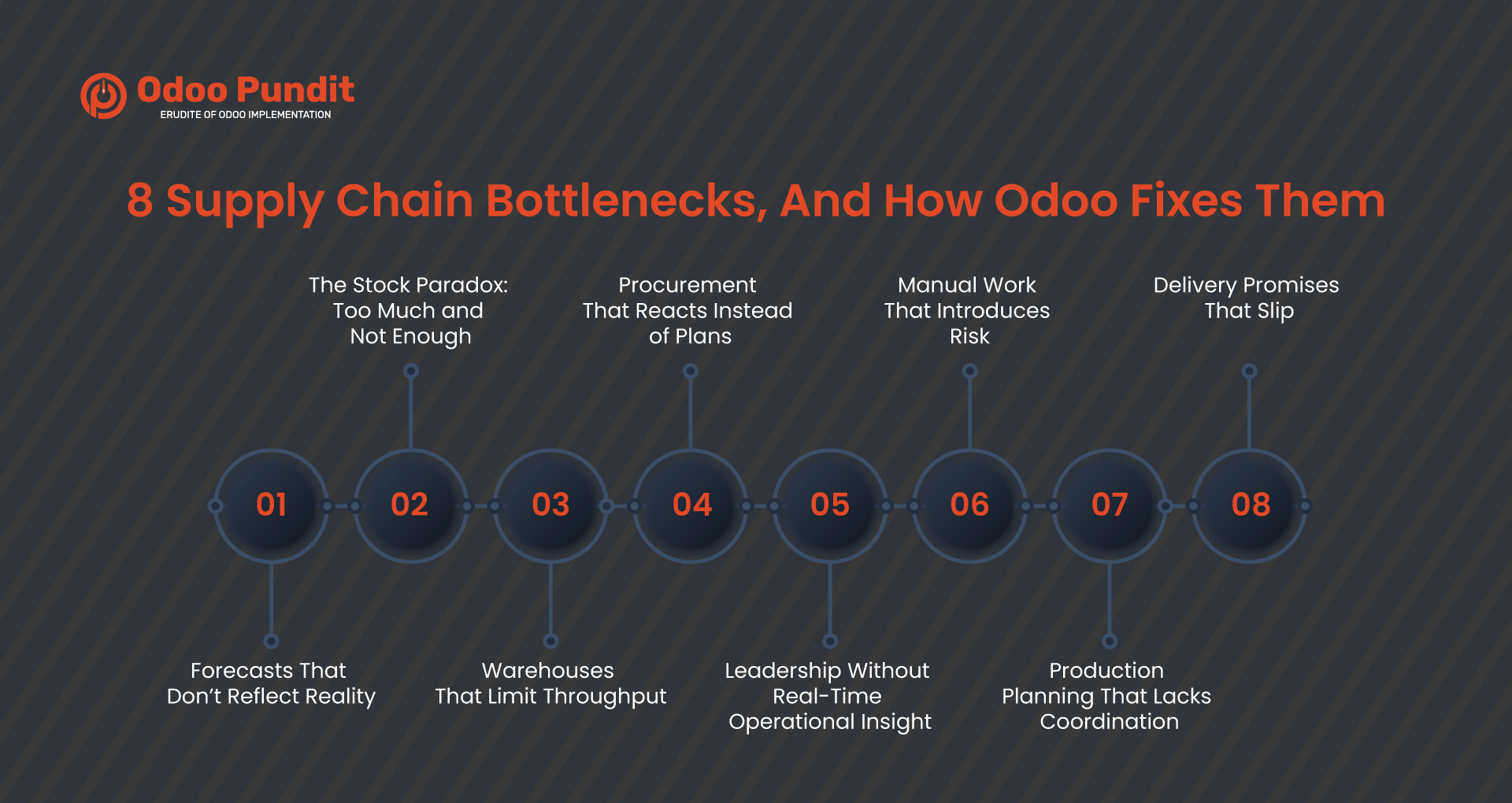 8 Supply Chain Bottlenecks, And How Odoo Fixes Them
1. Forecasts That Don’t Reflect Reality
Spreadsheet-based planning often leads to chronic overstocking or unexpected shortages.
Odoo uses forecasted inventory calculations built from transactional data, including:
- Current on-hand stock
- Incoming purchase receipts or production
- Confirmed sales demand
- Supplier lead times
- Manufacturing timelines
These projections are deterministic, based on known transactions and configuration, not AI-generated predictions.
Planners can see projected shortages before they occur and adjust procurement or production accordingly.
Outcome: Decisions based on expected future availability rather than historical reports.
2. The Stock Paradox: Too Much and Not Enough
Many businesses hold excess slow-moving items while critical components run out.
Odoo provides real-time visibility across warehouses, internal locations, packages, and tracked lots or serial numbers. Configurable replenishment rules can trigger:
- Draft purchase orders
- Manufacturing orders
- Internal transfers between warehouses
- Dropship procurements
Stock reservations allocate available inventory according to system configuration (such as FIFO, removal strategies, or priority rules when defined).
Outcome: Balanced inventory that supports operations without tying up excessive working capital.
3. Warehouses That Limit Throughput
Slow picking, misplacements, and shipping errors often result from unstructured processes rather than staffing shortages.
Odoo’s warehouse management capabilities include:
- Barcode scanning for all stock movements
- Batch, wave, and cluster picking strategies
- Putaway and removal rules for storage optimization
- Packaging management and units-of-measure handling
- Transfer grouping for efficient dispatch
- Lot and serial number tracking with full traceability
- Expiry date tracking for perishable goods
- Support for multi-step warehouse processes such as pick, pack, and ship
Staff follow system-guided workflows instead of relying on paper instructions or memory.
Outcome: Higher throughput, improved accuracy, and reduced operational friction.
4. Procurement That Reacts Instead of Plans
Manual purchasing cycles frequently cause late material arrivals and production delays.
Odoo calculates procurement needs automatically using demand data, lead times, and replenishment rules. Buyers receive quantity suggestions, and requests for quotation (RFQs) can be grouped by vendor.
Typical capabilities include:
- Vendor lead-time tracking
- Purchase dashboards with performance indicators
- Automatic generation of draft RFQs or purchase orders for review
- Monitoring of late deliveries and receipts
Organizations often formalize these processes during an Odoo implementation to standardize purchasing workflows across departments.
Outcome: Predictable material supply with human oversight rather than emergency ordering.
5. Leadership Without Real-Time Operational Insight
Executives often rely on periodic reports that no longer reflect current conditions.
Odoo provides live dashboards showing:
- Inventory levels and stock movements
- Order status across fulfillment stages
- Procurement progress
- Production performance
- Late or at-risk deliveries
- Backorders and fulfillment status
Exceptions such as shortages or delays are visible through reports and dashboards; additional automated alerts can be configured if required.
Dashboards provide operational insight; advanced analytics can be achieved through reporting tools or integrations.
Outcome: Proactive decision-making based on real operational data.
6. Manual Work That Introduces Risk
As transaction volumes increase, manual processes become major sources of errors and delays.
Odoo automates routine activities through configurable workflows:
- Approval processes
- Document generation across modules
- Status updates
- Notifications and task assignments
- Cross-department coordination
Organizations with unique requirements often refine these workflows using Odoo customization services so the system reflects actual operations rather than forcing workarounds.
Outcome: Reduced administrative burden and improved consistency.
7. Production Planning That Lacks Coordination
Manufacturers frequently struggle to align materials, machine capacity, and delivery commitments.
Odoo’s manufacturing resource planning tools coordinate:
- Multi-level bills of materials
- Work center scheduling and capacity planning
- Production timelines
- Material requirements
- Routing and batch sizing
- Lot and serial traceability throughout production
Work orders update in real time on the shop floor, feeding accurate progress data into delivery planning.
Manufacturers can extend this with integrated quality checks and maintenance workflows when needed.
Outcome: Stable production flow and improved on-time performance.
8. Delivery Promises That Slip
Late shipments damage customer trust and disrupt downstream planning.
Because sales, inventory, procurement, and manufacturing share the same data, delivery commitments reflect actual readiness.
Once orders are prepared, shipping operations become available and can be streamlined through carrier integrations that support:
- Shipping label generation
- Delivery cost calculation
- Tracking number assignment
- Status updates
- Supports dropshipping and multi-carrier shipping strategies.
If upstream delays occur, planners see the impact immediately rather than after the promised delivery date passes.
Outcome: More reliable fulfillment and improved customer satisfaction.
Why Businesses Choose an Integrated Supply Chain Approach
Addressing isolated problems provides temporary relief. Coordinating the entire supply chain delivers sustained improvement.
Key advantages include:
- Single source of truth: All departments operate from the same real-time data
- Operational resilience: Disruptions are detected early and managed systematically
- Scalability: Growth does not multiply complexity
- Cost optimization: Reduced excess inventory, emergency purchases, and manual effort
Technology alone does not guarantee success. Effective outcomes require disciplined processes, accurate data, and organizational alignment.
When Odoo Supply Chain Management Makes the Most Sense
This approach typically delivers strong value when:
- Operations span multiple warehouses or locations
- Demand variability complicates planning
- Inventory inaccuracies cause frequent disruptions
- Manual coordination consumes excessive time
- Leadership lacks timely operational insight
Organizations with very simple supply chains may not need a comprehensive ERP. However, once inefficiencies begin limiting growth or profitability, incremental fixes become ineffective.
Signs Your Business Has Outgrown Disconnected Systems
- Frequent stockouts despite high overall inventory
- Manual reconciliation between multiple systems
- Increasing delivery delays
- Difficulty obtaining real-time operational status
- Excess working capital tied up in inventory
These signals often indicate structural issues that integrated systems are designed to address.
What Odoo Will Not Fix Automatically
Even a well-implemented ERP cannot compensate for weak fundamentals.
Successful deployments require:
- Clean and reliable master data
- Clearly defined processes
- Ownership of responsibilities
- Training and change management
Technology amplifies effective practices and exposes deficiencies.
From Firefighting to Predictable Operations
The most significant transformation is not automation but stability.
Teams move from reacting to anticipating. Planning becomes data-driven. Departments coordinate naturally because they operate on shared information.
Operations feel controlled rather than chaotic.
If daily intervention is required simply to maintain continuity, structural alignment, not additional effort, is needed.
Moving Forward with Clarity
Before adopting any system, organizations should identify where friction truly originates. Some problems stem from outdated processes, others from fragmented technology, and many from both.
A structured evaluation can reveal:
- Which bottlenecks create the greatest cost or risk
- Whether process improvements alone are sufficient
- Where integration would deliver measurable gains
- How change can be implemented with minimal disruption
Addressing these questions early can prevent years of operational inefficiency.
Struggling with inventory chaos, delays, or lack of visibility?
Discover how an integrated Odoo supply chain solution could streamline your operations, request a no-obligation assessment today.
FAQs
It is an integrated set of ERP applications that manage procurement, inventory, warehousing, manufacturing, and delivery within a single system, providing real-time visibility and coordinated planning.
Yes. Odoo supports multi-warehouse operations, internal transfers, routing rules, and centralized control of inventory across locations.
Yes. Odoo includes manufacturing resource planning capabilities such as bills of materials, work centers, production scheduling, and shop-floor tracking.
By consolidating operational data into one platform, Odoo provides real-time dashboards, traceability, and exception reporting across the entire supply chain.
Timelines vary depending on scope, data readiness, and number of modules. Many mid-market organizations deploy in phases rather than a single full rollout.