Short answer: Odoo is generally better for operations-heavy, product-based, or complex organizations, while Zoho is ideal for customer-centric, service, and digital businesses that need speed and simplicity. The right choice depends less on company size and more on how your business creates value.
Choosing between Odoo vs Zoho is not just a software decision; it’s a strategic choice that will shape your efficiency, reporting accuracy, and ability to scale for years. Both platforms promise an all-in-one business management system, yet they grow in very different ways. Odoo functions as a deeply integrated ERP designed to run complex operations end-to-end, while Zoho offers a unified cloud suite optimized for usability, collaboration, and customer growth.
As organizations expand, they face more departments, higher transaction volumes, stricter compliance needs, and increasing demand for real-time insights. The right platform should support this complexity without forcing costly migrations later.
Quick Verdict: Odoo vs Zoho by Business Type
Business Scenario | Recommended Platform | Why It Fits |
Manufacturing / Distribution | Odoo | Strong inventory, MRP, operations |
Multi-company / Multi-entity | Odoo | Unified database & reporting |
Service Agency | Zoho | CRM + collaboration focus |
SaaS / Digital Business | Zoho | Customer lifecycle tools |
Retail with complex supply chain | Odoo | Procurement & logistics depth |
Sales-driven SMB | Zoho | Fast deployment & automation |
👉 If operations are your complexity, lean toward Odoo.
👉 If customers and growth funnels are your priority, lean toward Zoho.
Odoo vs Zoho at a Glance, Core Differences That Matter
At a strategic level, this comparison is between an integrated ERP platform and a cloud business operating system composed of tightly connected applications.
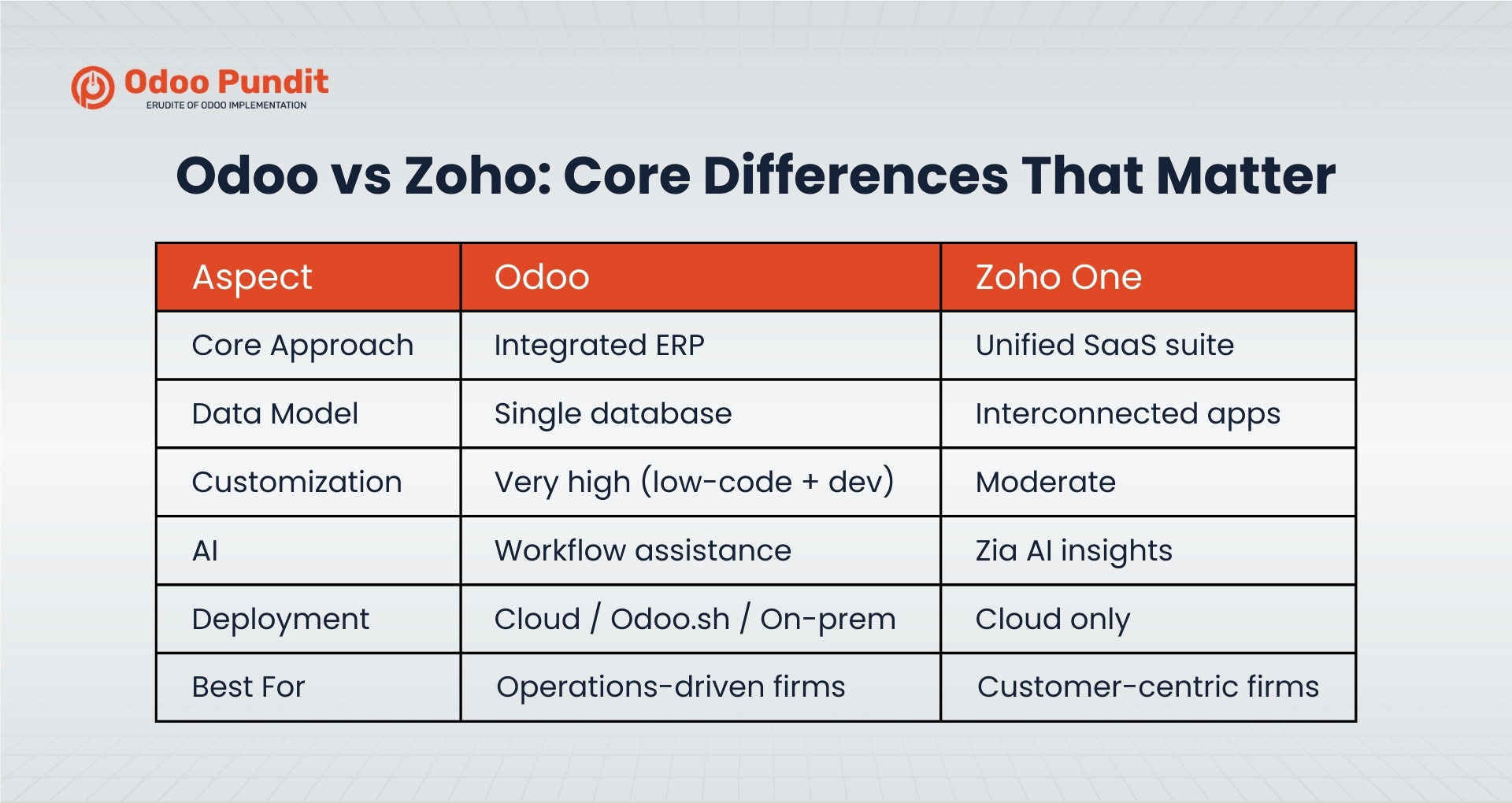
Key takeaway: Odoo centralizes business processes; Zoho centralizes business tools.
Odoo Overview – Built for Operational Complexity
Odoo is a modern ERP platform designed for companies whose growth depends on efficient operations, production, logistics, or tightly integrated workflows.
Why Odoo Scales Well
Odoo runs on a single unified data model, meaning every department works from the same real-time information.
For example:
- Sales orders update inventory instantly
- Procurement triggers automatically
- Production schedules adjust dynamically
- Invoices and accounting entries generate automatically
- Leadership dashboards update in real time
This eliminates the fragmented reporting common in multi-tool environments.
Key Strengths for Growing Companies
- Fully integrated CRM and ERP
- Modular apps that expand as needed
- Advanced automation workflows
- Multi-company support
- Strong manufacturing and inventory management
- Centralized analytics and reporting
Odoo also includes practical AI-assisted features that help process documents, analyze data, and suggest actions, enhancing productivity without removing human oversight.
Low-Code Customization Advantage
A major differentiator is Odoo’s low-code customization environment. Businesses can adapt workflows, forms, reports, and automations without rebuilding the system.
Organizations with complex needs often rely on expert Odoo implementation support to align the platform with real operational processes.
Trade-Offs to Consider
- Longer implementation timeline
- Requires clear process definition
- Higher upfront investment
- Change management needed
When implemented correctly, however, Odoo can serve as a long-term system of record without replacement.
Zoho One Overview – Built for Speed and Customer Growth
Zoho One is a cloud business operating system designed for digital, service-oriented, and sales-driven organizations.
Where Zoho Excels
Zoho prioritizes rapid deployment and ease of use.
- Fast setup with minimal configuration
- Intuitive interfaces across apps
- Predictable subscription pricing
- Centralized admin and security controls
- Low IT dependency
Unified workspaces allow teams to organize tools by function, improving coordination as the company grows.
AI-Driven Insights with Zia
Zoho’s Zia AI provides:
- Predictive analytics
- Sales forecasting
- Anomaly detection
- Conversational reports
- Workflow recommendations
These features are especially valuable for marketing, sales, and service teams.
Integration Model Explained
Zoho apps share data and can automate workflows across the suite, but each application still operates independently, unlike Odoo’s single-database approach.
Where Scaling Can Become Challenging
Zoho works extremely well for standardized processes. Limitations may appear when businesses require:
- Advanced manufacturing planning
- Complex supply chain coordination
- Highly customized operations
- Large-scale inventory control
Service and digital companies typically encounter fewer constraints.
Odoo vs Zoho Features Comparison for Scaling Operations
CRM Capabilities
Both platforms offer powerful CRM tools.
- Zoho CRM: Excellent for sales automation and marketing
- Odoo CRM: Deeply connected to operations and finance
If closing a deal triggers production or fulfillment, Odoo’s integration reduces manual handoffs.
Operations, Inventory, and Manufacturing
Function | Odoo | Zoho |
Inventory | Advanced | Moderate |
Manufacturing | Native MRP | Limited |
Procurement | Automated | Basic |
Financial Integration | Real-time | App-based |
Product-centric companies typically prefer Odoo.
Cross-Department Coordination
Odoo excels when teams are tightly interdependent.
Zoho works best when departments operate more independently.
Odoo vs Zoho Pricing – Real Cost Over Time
Zoho: Lower Initial Investment
- Simple subscription pricing
- Minimal setup costs
- Predictable monthly expenses
Costs may rise if additional tools or integrations become necessary.
Odoo: Higher Upfront, Strong Long-Term Value
- Pay for per users
- Implementation investment required
- Customization may add cost
Companies with specialized processes often use Odoo development services to tailor the system for efficiency, which can produce significant ROI over time.
Hidden Costs Most Businesses Miss
- Data migration
- Staff training
- Process redesign
- Integration maintenance
- Future scalability needs
Switching systems later is far more expensive than choosing correctly upfront.
Implementation Difficulty: Speed vs Sustainability
Factor | Odoo | Zoho |
Deployment Speed | Slower | Fast |
Configuration | High | Moderate |
Expert Support | Often needed | Sometimes |
Long-Term Efficiency | Very high | Moderate–high |
Organizations comparing Odoo vs Zoho implementation difficulty should evaluate long-term sustainability, not just speed to launch.
Which Platform Grows with Your Business Long Term?
For Startups
Zoho typically provides faster initial traction.
For Mid-Size Firms with Multiple Teams
Odoo becomes increasingly valuable as coordination complexity rises.
Common signs you may outgrow a lightweight system:
- Fragmented reporting
- Manual data reconciliation
- Operational bottlenecks
- Limited visibility across departments
For Large or Complex Organizations
Odoo generally offers greater headroom for scaling operations, compliance, and multi-entity management.
Odoo vs Zoho Pros and Cons, At a Glance
Choose Odoo If You Need:
- Deep operational control
- Manufacturing or logistics capabilities
- Custom workflows
- Unified data across departments
- Long-term ERP backbone
Choose Zoho If You Need:
- Rapid deployment
- Customer-centric tools
- Lower upfront cost
- Standardized processes
- Minimal IT overhead
Final Verdict: Odoo vs Zoho – Which Should You Choose?
The Odoo vs Zoho decision ultimately depends on how your organization creates value.
- If growth is driven primarily by customers, sales, and service delivery – Zoho excels
- If growth depends on operations, production, or complex workflows – Odoo excels
Both platforms are modern, AI-enabled, and capable of supporting significant scale. The key is selecting the one aligned with your business model, not just your current size.
Zoho is rapidly expanding into ERP capabilities, but organizations with complex manufacturing or supply chain requirements still typically prefer dedicated ERP platforms like Odoo.
Before deciding, map your future organization, how teams will collaborate, how processes will evolve, and where complexity will increase. The right system should enable that journey, not constrain it.
Organizations should evaluate implementation expertise, ecosystem support, and total cost of ownership alongside feature comparisons, as these factors often determine long-term success.
Still Unsure Which Platform Fits Your Growth Plan?
Start by mapping your core processes, expansion strategy, and operational priorities. A clear roadmap will make the right choice obvious and prevent costly system changes later.
FAQs
Zoho is usually better early due to speed and simplicity. Odoo becomes advantageous as operational complexity increases.
Yes for service-oriented organizations, but operations-heavy enterprises often require deeper ERP capabilities.
Not necessarily. With proper implementation, it can provide structure and automation that support growth.
Typically, when operations become fragmented across tools or when advanced inventory, manufacturing, or reporting needs emerge.