HR teams today manage much more than attendance or payroll. They are expected to understand workforce capabilities, identify skill gaps, develop talent pipelines, and support leadership with people data that aligns hiring and staffing decisions with business goals. Doing all of this manually becomes difficult as organizations grow or operate across multiple locations.
This is why many companies adopt the Odoo HR module to centralize employee data and streamline HR processes. Odoo brings employee profiles, performance information, skills, training activities, and resource planning together inside a connected system. With the right configuration and the right extensions, it becomes a strong foundation for long-term workforce planning.
Before diving deeper, it’s important to understand one key point:
Odoo provides core HR and skills features out-of-the-box, while advanced skill matrices, automated proficiency scoring, predictive forecasting, or competency dashboards typically require add-ons or light customization.
This mix of native functionality + extensibility is what makes Odoo suitable for both simple HR setups and advanced talent-management environments.
In this blog, we’ll explore how the Odoo HR module supports skills mapping and workforce planning, what’s included natively, and which capabilities may require configuration, third-party modules, or customization.
Why Skills Mapping & Workforce Planning Matter More Than Ever
Skills and workforce insights have become essential for business stability and competitiveness. Here’s why modern HR teams prioritize them:
1. Industries evolve quickly
Roles change faster than traditional HR systems can keep up. Organizations need a reliable way to understand employee capabilities and detect potential skill shortages.
2. Workforces are becoming multi-skilled
Employees today often need hybrid skills—technical, managerial, digital, compliance, and communication skills—making manual tracking nearly impossible.
3. HR needs one source of truth
A structured workforce skills database ensures managers and leaders make decisions based on accurate, connected information.
4. Development must be strategic
Without visibility, training becomes reactive instead of aligned with future workforce needs.
5. Workforce forecasting supports stability
Estimating staffing needs helps organizations plan project capacity, manage demand cycles, and prepare for growth.
Odoo supports HR teams in centralizing and structuring this information so they can plan proactively.
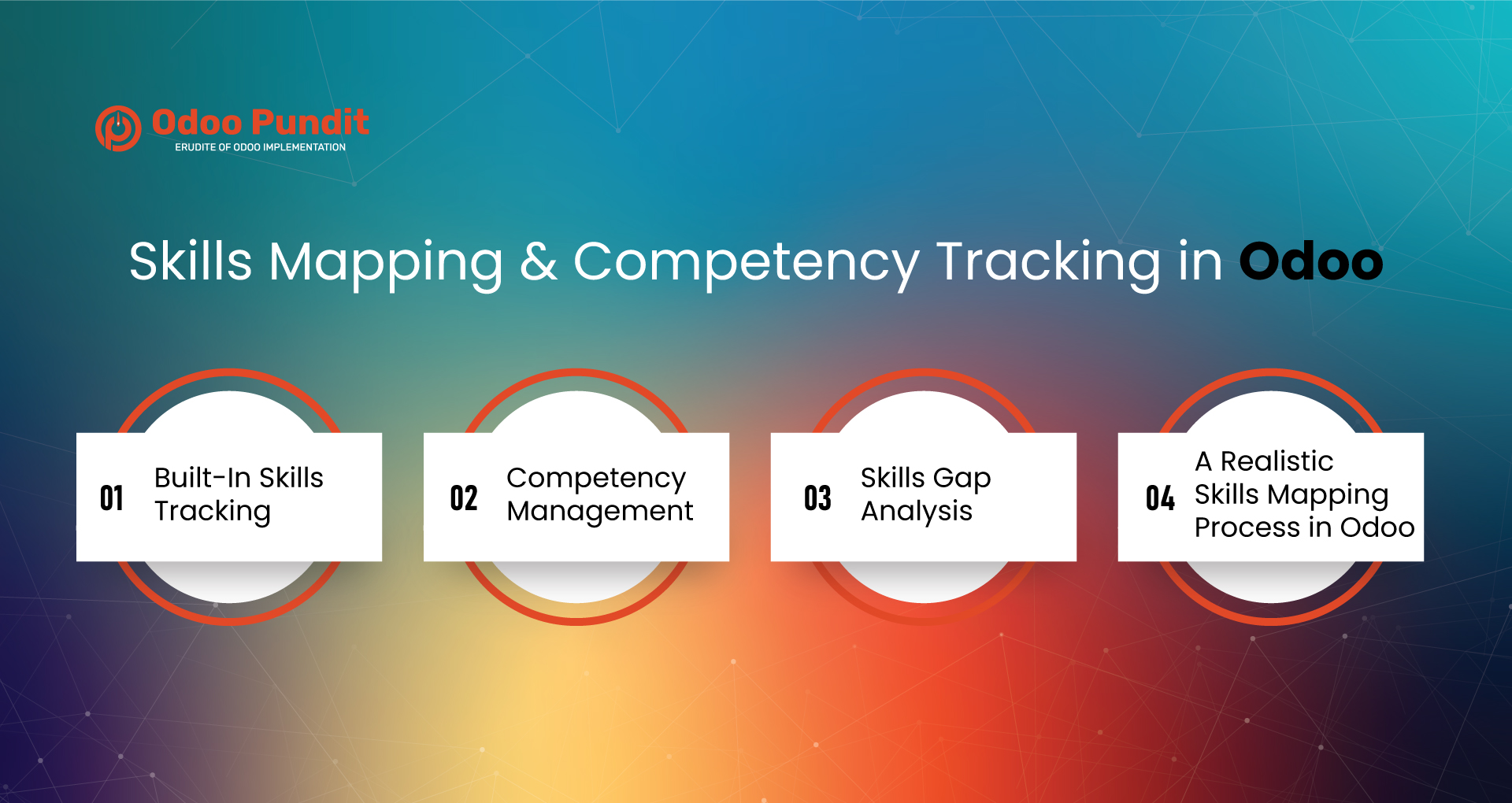
Skills Mapping & Competency Tracking in Odoo (Core + Extended Capabilities)
Odoo provides strong foundations for skills mapping. With the right add-ons or customization, these foundations can be expanded into full competency-management systems.
1. Built-In Skills Tracking (Native Feature)
Odoo includes a Skills section inside every employee profile where HR teams can define:
- Skill Types
- Skill Levels
- Experience Indicators
- Certifications or Qualifications
These fields can be updated during onboarding, evaluations, appraisals, or role changes. This forms the base layer of skills mapping for most organizations.
Odoo lets you configure Skill Types in:
Employees → Configuration → Skill Types
2. Competency Management (Native + Add-Ons for Advanced Needs)
Basic competency tracking is supported through:
- Employee profiles
- Appraisal feedback
- Skill evaluations
However, advanced competency management — such as:
- Skill heatmaps
- Competency matrices
- Automated skill scoring
- Team-level skill comparisons
- Capability dashboards
is not native and typically requires:
- Marketplace modules
- Configuration
- Small customizations
For visual matrices, many teams use marketplace add-ons such as Employee Dynamic Skill Matrix, which provides heatmaps and exportable reports built on top of Odoo’s native skills data.
3. Skills Gap Analysis (Partially Native, Fully Achievable with Extensions)
Odoo allows manual skill-gap analysis by:
- Reviewing employee profiles
- Comparing skills to job requirements
- Evaluating appraisal results
For deeper analytics, organizations often use extensions that offer:
- Automated skill-gap identification
- Visual dashboards
- Training recommendations based on missing skills
- Gap progression tracking over time
This hybrid (core + extended) model is how most HR teams manage skills gaps in Odoo.
4. A Realistic Skills Mapping Process in Odoo
A typical skills mapping workflow looks like this:
- Define skill frameworks (native)
- Set rating scales (native)
- Assign skills to employees (native)
- Update skills during appraisals (native)
- Install dashboards for visualization (extended)
- Connect training outcomes to skill updates (extended)
This allows companies to scale competency tracking gradually.
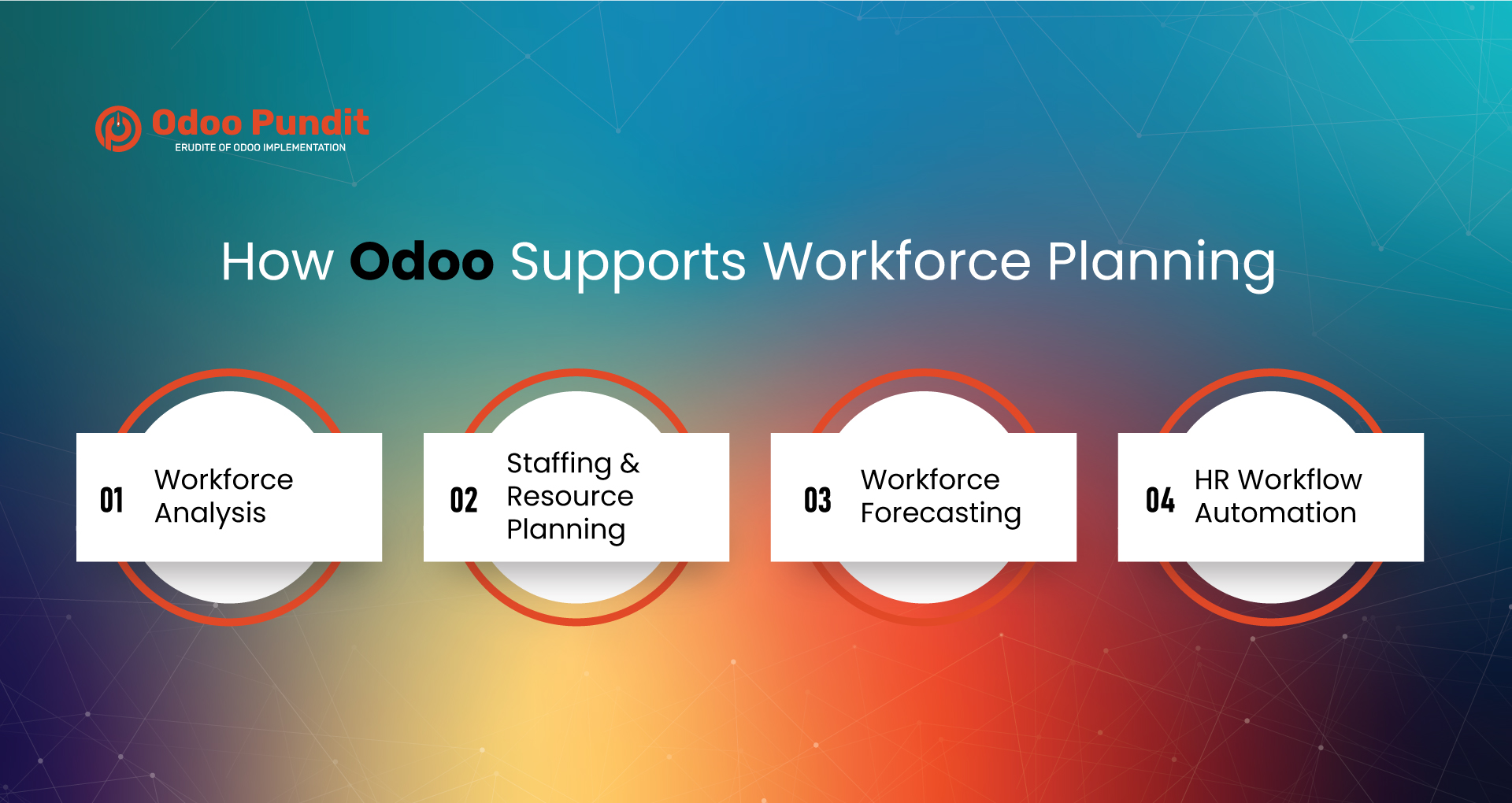
How Odoo Supports Workforce Planning (Accurate Core vs Extended Breakdown)
Workforce planning inside Odoo uses a combination of core HR data and extended modules.
1. Workforce Analysis (Native Dashboards)
The HR Dashboard provides insights into:
- Headcount
- Contract structures
- Employee availability
- Department organization
- Allocations
These high-level views support workforce analysis and HR decision-making.
2. Staffing & Resource Planning (Core + Enhanced with Add-Ons)
Odoo supports assigning employees to tasks or projects based on:
- Availability
- Roles
- Skills (reviewed manually)
- Experience or seniority
When combined with:
- Planning (resource scheduling & shifts)
- Project (task assignments)
- Timesheets (capacity tracking)
…Odoo becomes a structured operational planning system.
Planning’s “Auto Plan” assigns open shifts based on roles and shift templates — it does not perform multi-dimensional skill matching.
Advanced auto-matching requires configuration or add-ons.
3. Workforce Forecasting (Extended Capability)
Odoo 19 does not include predictive workforce forecasting as a native HR feature.
Companies generally achieve forecasting through:
- Planning + Project + HR data
- Analytic dashboards
- Marketplace forecasting modules
- Light customization
This enables forecasting for:
- Future hiring needs
- Project-based workforce demands
- Seasonal staffing
- Succession planning
4. HR Workflow Automation (Core + Extended)
Odoo includes a powerful native automation engine.
Native automations include:
- Appraisal reminders
- Contract renewal alerts
- Document expiry notifications
- Skill updates via appraisal workflows
Extended automations can include:
- Auto-update skills after course completion
- Role-based onboarding flows
- Skill-based auto-assignment
- Shortage predictions
These extended automations require marketplace modules or customization.
Training, Development & Performance Management in Odoo
1. Training & eLearning (Native App)
With Odoo’s eLearning module, organizations can:
- Publish internal courses
- Track learner progress
- Conduct assessments
- Issue certifications
If companies want training completions to automatically update skill levels, this typically requires a customization or an LMS integration module.
Odoo includes a Certifications report under:
Employees → Reporting → Certifications
(Note: The Certifications report requires the Surveys app to be installed.)
2. Employee Development (Native + Extended)
Employee development is supported through:
- Regular appraisals
- Manager feedback
- Skill updates
- Training participation
For structured growth paths, companies often use:
- Third-party training lifecycle apps
- Automated skill-progression workflows
- Role-based development plans
3. Performance Appraisals (Native Feature)
The appraisal system supports:
- Quarterly reviews
- Annual reviews
- 90-day evaluations
- Competency-based scoring
Each appraisal includes a Skills Evolution section showing progress over time, supporting both development planning and workforce strategy.
Best Practices for Workforce Planning Using Odoo
To maximize the value of Odoo, HR teams typically:
- Update skill data continuously
- Align appraisals with skills evaluation
- Combine Planning + Projects + HR modules
- Review staffing insights regularly
- Link training to skill gaps
- Use analytics add-ons for deeper reporting
Real-World Use Cases
Technology Teams
Track programming skills, frameworks, certifications, and assign developers accurately.
Manufacturing
Monitor operator certifications, machine skills, and compliance requirements.
Consulting & Professional Services
Match consultants to client projects based on domain expertise & communication skills.
Why Odoo HR Module Is Valuable for Modern HR Teams
Odoo’s strength lies in combining native HR features with flexible extensions. When implemented correctly, organizations can:
- Build a structured skills database
- Improve workforce planning accuracy
- Streamline HR workflows
- Support learning and development
- Increase transparency across teams
- Align HR with business goals
For deeper HR analytics and competency frameworks, companies often use customization or marketplace solutions.
Final Thoughts
Skills mapping and workforce planning are essential for organizations preparing for the future. Odoo provides the core features to manage these processes effectively, and with the right enhancements, it can evolve into a complete talent-management environment.
Whether you’re starting with foundational HR workflows or building advanced workforce planning capabilities, Odoo offers the flexibility, modular design, and scalability needed across diverse industries.
Ready to optimize your workforce strategy?
Discover how Odoo HR can transform your skills mapping and planning today.