Digital health is moving faster than ever. Healthcare providers across regions, small clinics, multi-specialty practices, and large hospitals, are all looking for flexible, affordable, and scalable digital systems. In this evolving landscape, Odoo for healthcare has emerged as one of the most talked-about solutions. Its growing popularity isn’t surprising. Providers want systems that streamline patient care, reduce administrative stress, and bring multiple functions into one connected platform.
With the release of the new version, Odoo introduced stronger performance, better workflow tools, improved automation, and deeper integration capabilities, making it even more valuable for modern healthcare organizations. As digital health solutions continue to accelerate, Odoo has positioned itself as a unified system capable of supporting both operational efficiency and patient-centric care.
Why Odoo for Healthcare Is Trending in 2025
Healthcare providers are now prioritizing smooth digital experiences, not only for patients but also for their internal teams. The shift toward digital healthcare trends is being driven by several factors:
1. Need for cost-effective digital health solutions
Traditional Hospital Information Systems (HIS) often require heavy investments and long deployment cycles. Many smaller or mid-sized facilities simply can’t justify the cost. Odoo provides an alternative that is affordable yet robust, helping organizations adopt modern healthcare technology solutions without stretching budgets.
2. Rising preference for cloud-based healthcare platforms
Cloud adoption is becoming a standard. Healthcare providers want systems that can be accessed anywhere, allow real-time updates, and reduce hardware dependencies. Odoo supports these expectations with secure, cloud-ready capabilities and a modular structure.
3. Increasing demand for integrated patient and operations management
Clinics and hospitals no longer want separate systems for billing, appointments, records, inventory, and communication. The industry wants a unified healthcare platform that connects end-to-end workflows, and this shift is making Odoo highly appealing.
4. Focus on automation and efficiency
Administrative burden is one of the biggest challenges for healthcare teams. With its ability to automate processes and integrate EMR and ERP workflows, Odoo significantly reduces manual effort and helps staff focus on what matters, patient care.
Overview of Odoo’s New Capabilities for Healthcare
The latest Odoo release brought major improvements that directly benefit healthcare providers. These include:
- A cleaner, faster backend interface
- Stronger access controls for sensitive records
- More flexible scheduling and calendar management
- Better workflow automation
- Upgraded communication tools for staff and patients
- Enhanced APIs for EMR and ERP integration
- More customization power through its visual development tools
Together, these enhancements make Odoo more adaptable and efficient for clinics, diagnostic centers, and medical practices looking to modernize operations.
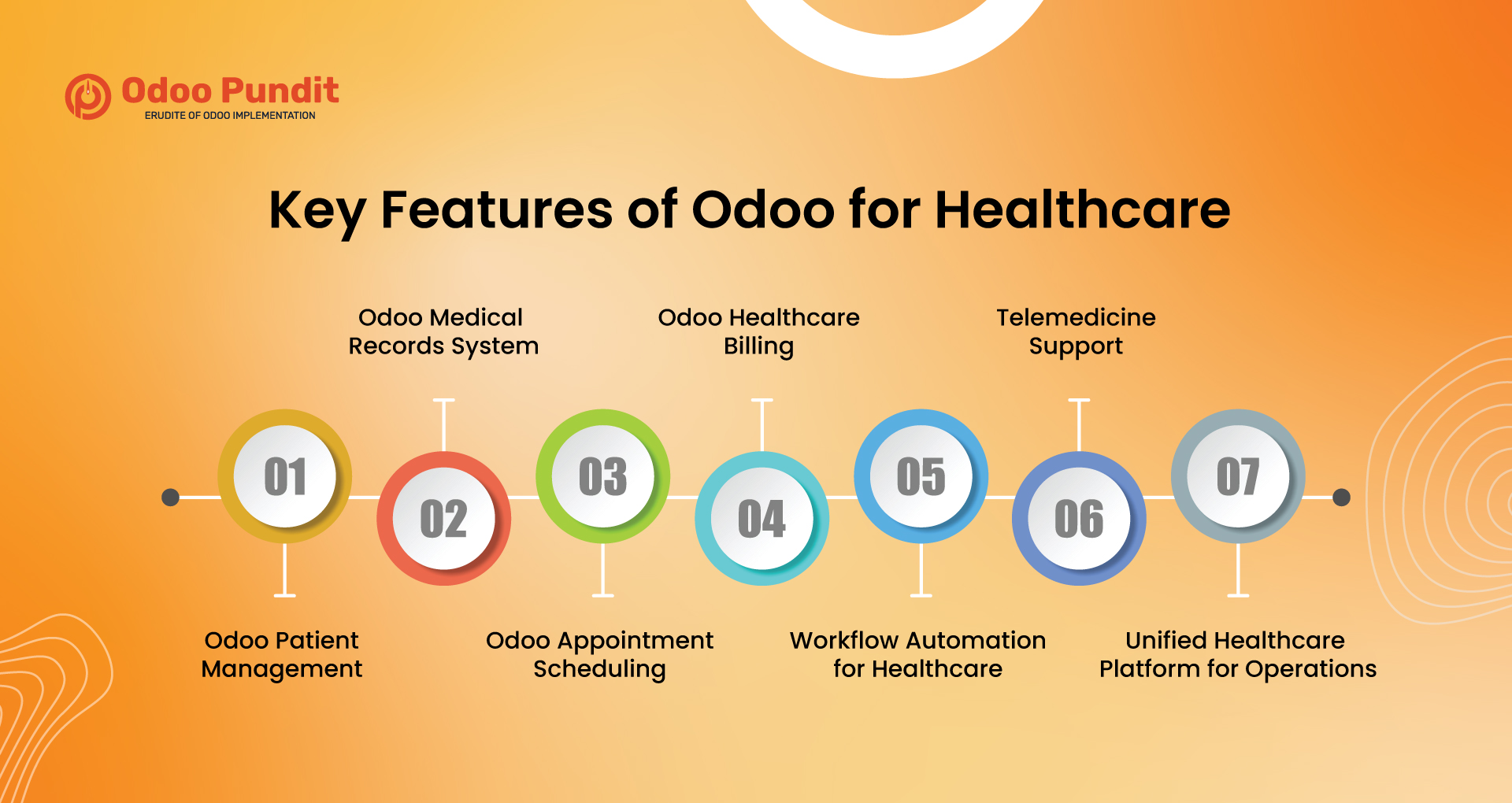
Key Features of Odoo for Healthcare
Odoo is not just an ERP, it evolves into a complete healthcare management system when paired with the right modules. Below are the most impactful features used by healthcare organizations across multiple regions.
1. Odoo Patient Management
This module acts as the backbone of digital healthcare operations. Providers can easily maintain:
- Unified patient profiles
- Medical history and treatment timelines
- Integrated billing and appointment information
- Connected workflows across departments
It creates a seamless patient data management system where all essential information is centralized.
2. Odoo Medical Records System
Managing electronic medical records is one of the biggest challenges in healthcare. Odoo simplifies this by offering:
- Structured medical record storage
- Access-based permissions for enhanced data security
- Easy linkage with lab results, prescriptions, and clinical notes
Its approach to electronic medical records management helps maintain confidentiality while improving decision-making.
3. Odoo Appointment Scheduling
Outdated booking systems cause patient frustration and staff overload. Odoo’s appointment management tools provide:
- Online appointment booking
- Doctor availability calendars
- Auto-reminders by SMS or email
- Rescheduling workflows
- Integrated payments (optional)
This improves the patient experience and reduces no-show rates.
4. Odoo Healthcare Billing
Odoo’s integrated billing capabilities eliminate the need for separate financial software. Healthcare providers can:
- Automate invoice creation
- Manage multiple payment methods
- Link services directly to billing entries
- Track financial health using dashboards
It becomes easier to maintain transparency for patients while keeping accounts teams aligned.
5. Workflow Automation for Healthcare
One of the strongest reasons Odoo is trending in the healthcare industry is its automation engine. Clinics and hospitals can automate:
- Lab test requests
- Prescription approvals
- Appointment reminders
- Report generation
- Internal communication between units
For laboratory operations, Odoo does not generate clinical lab reports natively, but it integrates seamlessly with external Laboratory Information Systems (LIS) to sync test requests, status updates, and final reports via API. This allows teams to maintain a unified operational flow without replacing specialized lab software.
This significantly reduces repetitive tasks and minimizes errors.
6. Telemedicine Support
Modern healthcare needs hybrid care models, and Odoo plays a role here as well. Its telemedicine integration enables:
- Secure video consultations
- Digital prescription sharing
- Remote follow-ups
- Online document exchange
This makes virtual care accessible and organized.
7. Unified Healthcare Platform for Operations
Odoo can function as a connected hospital information system where multiple departments operate on a single platform:
- Reception
- Nursing
- Pharmacy
- Diagnostics
- Billing
- Inventory
- HR
- Finance
For pharmacy operations specifically, Odoo’s inventory module supports batch tracking, expiry management, vendor pricing, stock movements, and replenishment rules. Healthcare providers often extend these features with light customization when they require barcode-based dispensing workflows or regulated drug-handling processes.
With real-time dashboards, teams can track performance, patient flow, stock levels, and resource utilization effortlessly.
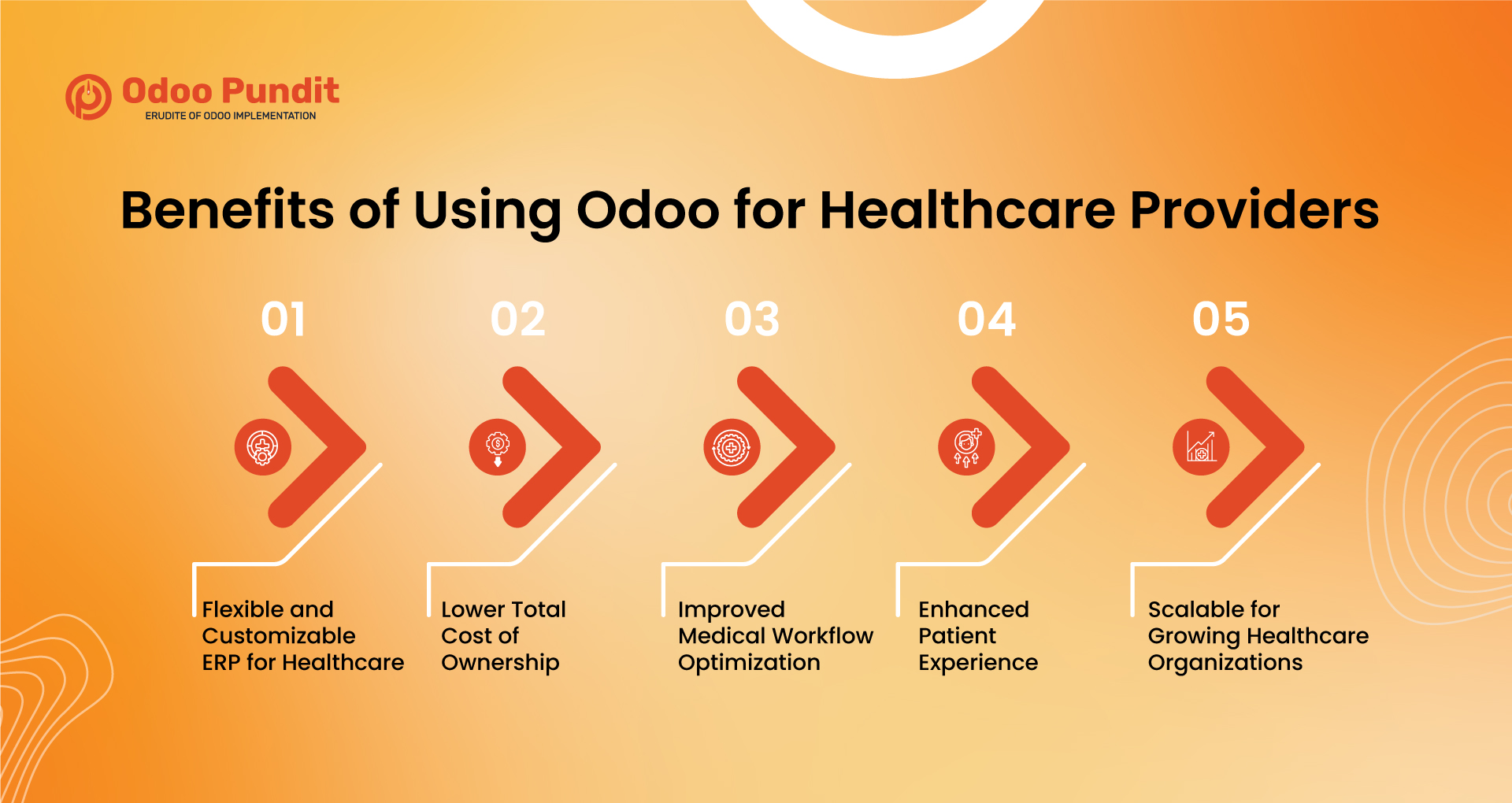
Benefits of Using Odoo for Healthcare Providers
Healthcare organizations choose Odoo because it brings together affordability, flexibility, and technological strength, all in one solution.
1. Flexible and Customizable ERP for Healthcare
Unlike rigid healthcare management systems, Odoo can adapt to:
- Specialist clinics
- General practices
- Multi-specialty facilities
- Labs and diagnostic centers
- Medical service networks
Its modular design allows providers to choose only the functionalities they need. When combined with professional Odoo customization, the platform can support advanced workflows unique to each organization.
2. Lower Total Cost of Ownership
Healthcare facilities no longer want ERP systems that come with heavy license costs and long-term contracts. Odoo’s pricing structure, combined with its open architecture, helps providers stay within budget while still accessing enterprise-level features.
3. Improved Medical Workflow Optimization
Automation and structured processes reduce delays and eliminate manual errors. Odoo allows healthcare teams to:
- Manage appointments faster
- Coordinate between departments
- Speed up billing cycles
- Improve medical documentation accuracy
Teams can focus more on patients and less on administrative routines.
4. Enhanced Patient Experience
Patients appreciate simplicity. With Odoo, healthcare providers can offer:
- Easy digital bookings
- Faster check-ins
- Transparent billing
- Quick access to reports
- Better communication
These builds trust and loyalty while improving overall satisfaction.
5. Scalable for Growing Healthcare Organizations
Whether a facility is expanding its workforce, opening new departments, or launching new services, Odoo scales smoothly. As an organization grows, additional modules or integrations can be added without disrupting existing workflows.
This scalability becomes even more seamless when facilities engage in professional Odoo implementation services to ensure a smooth, structured deployment.
Odoo for Healthcare vs. Traditional Management Systems
Feature | Traditional Systems | Odoo for Healthcare |
Cost | High | Affordable |
Customization | Limited | Extensive |
Integration | Difficult | API-friendly |
User Experience | Outdated | Modern & intuitive |
Scalability | Limited | Highly scalable |
This comparison shows why Odoo is becoming a preferred choice for modern healthcare facilities.
How Odoo Supports Digital Health Transformation
Healthcare is undergoing a data-driven transformation, and Odoo aligns perfectly with this direction.
Connected Systems
Odoo links EMR, billing, inventory, HR, finance, and appointments into one ecosystem.
Automation for Efficiency
Repetitive tasks are reduced, allowing healthcare teams to work more efficiently.
Real-time Insights
Dashboards and reports help leadership teams make accurate, informed decisions.
Cloud-ready Operations
Healthcare organizations can operate smoothly with minimal infrastructure overhead.
For deeper insights into how healthcare providers improve compliance and operational efficiency using Odoo, you can refer to this helpful resource on how Odoo improves healthcare efficiency and compliance
Real-World Use Cases of Odoo in Healthcare
Organizations use Odoo to manage:
- Multi-location clinics
- Diagnostics and laboratories
- Medical specialty practices
- Rehabilitation and wellness centers
- Clinical research operations
Its adaptability makes it suitable for diverse healthcare environments.
Customizing Odoo for Healthcare Needs
Every healthcare organization has unique processes. Odoo supports customization through:
- Workflow adjustments
- Department-specific features
- Custom reports
- Third-party modules
- API integrations
- Automated approval chains
Odoo’s built-in access control, record rules, and audit logs provide a strong foundation for secure data management. However, regulatory compliance depends on infrastructure decisions, such as hosting, encryption, and backups, not the software alone, giving organizations the flexibility to meet different governance standards.
This ensures that the system grows with the organization. The ability to easily configure processes allows healthcare teams to shape Odoo around their existing best practices rather than changing everything to fit the system.
Conclusion
Healthcare is evolving quickly, and the demand for efficient, connected, and patient-centered digital solutions is rising. Odoo for healthcare meets these needs with an adaptable, cost-effective, and future-ready system. Whether you run a small clinic or a growing medical network, Odoo helps streamline tasks, automate workflows, strengthen patient engagement, and create a unified operational ecosystem.
If your healthcare organization is planning to modernize and improve efficiency, exploring the potential of Odoo could be a major step forward.
Frequently Asked Questions
Is Odoo good for healthcare providers?
Yes. Odoo offers a complete suite of modules tailored to healthcare workflows, appointments, billing, records, inventory, and more, making it suitable for clinics, hospitals, and specialty practices.
What are the benefits of a healthcare management system built on Odoo?
It is customizable, affordable, integrated, and user-friendly. It helps streamline operations, improve patient experience, and reduce administrative tasks.
Can Odoo replace traditional hospital management software?
In many cases, yes. Odoo provides HIS-like functionalities while being more flexible and cost-effective.
Does Odoo support EMR and patient data management?
Yes. Odoo supports secure electronic medical records, access controls, and structured patient data workflows.
Can hospitals automate operations using Odoo?
Absolutely. Appointment reminders, billing flows, lab tests, approvals, and many daily tasks can be automated.
Is Odoo the best ERP for digital health in 2025?
With its modular approach, integrated tools, and improved performance, Odoo is among the most promising ERP options for modern digital health needs.
Book a Free Consultation.
Discover the right Odoo healthcare solution for your facility.