Service businesses rarely struggle because of a lack of demand. More often, profits disappear through small gaps untracked hours, unmanaged expenses, delayed billing, or projects that quietly exceed their budgets. Over time, these issues compound, leading to lower margins even when teams are working at full capacity.
If your projects feel busy but profitability remains unclear, the issue is usually not effort, it is visibility. Modern ERP solutions such as Odoo project management combine time tracking, cost control, purchasing, and billing into one connected workflow. This allows service organizations to understand real project profitability before projects finish, not months later.
By linking tasks, timesheets, expenses, purchasing, budgets, and invoicing through analytic accounting and sales workflows, Odoo provides a real-time view of both project costs and revenue while work is still underway helping prevent revenue leakage that often reaches 10–30% in project-based businesses.
This article explains how accurate time tracking, combined with properly configured project, budgeting, and financial workflows, helps service firms move from reactive reporting to controlled profitability.
What Is Odoo Project Management?
Odoo project management is an integrated system that connects tasks, timesheets, expenses, purchasing, and billing through analytic accounting. It enables organizations to track project performance, costs, and revenue in real time, making it easier to monitor margins and control delivery outcomes.
Unlike standalone project tools, it functions as part of a broader ERP for service companies, linking operational work directly to financial results.
Why Service Firms Struggle with Project Profitability
Many service organizations deliver excellent work yet still experience uneven margins. The problem is rarely demand, it is visibility into the true cost and revenue of delivery.
Revenue Leakage from Untracked Time and Scope Creep
Employees often perform work that never reaches the timesheet: quick calls, internal coordination, troubleshooting, or minor revisions. Each instance seems small, but across multiple projects these hours accumulate into significant lost billable effort.
Scope creep worsens the issue. Without disciplined tracking tied to contracts and budgets, teams continue delivering additional work without recognizing its financial impact.
Disconnected Systems for Projects, Purchasing, and Billing
When project management, accounting, and procurement operate in separate tools, data must be manually consolidated. This leads to delays, errors, and incomplete financial insight:
- Project managers lack current cost information
- Finance teams lack operational context
- Billing is based on partial data
- Vendor expenses appear too late
An integrated project accounting software platform removes these silos by connecting operational and financial workflows.
Lack of Real-Time Cost and Revenue Visibility
Financial reports typically reveal performance after projects conclude. By then, corrective action is impossible. Leaders need insight during execution to adjust staffing, scope, spending, or billing strategies before profitability erodes.
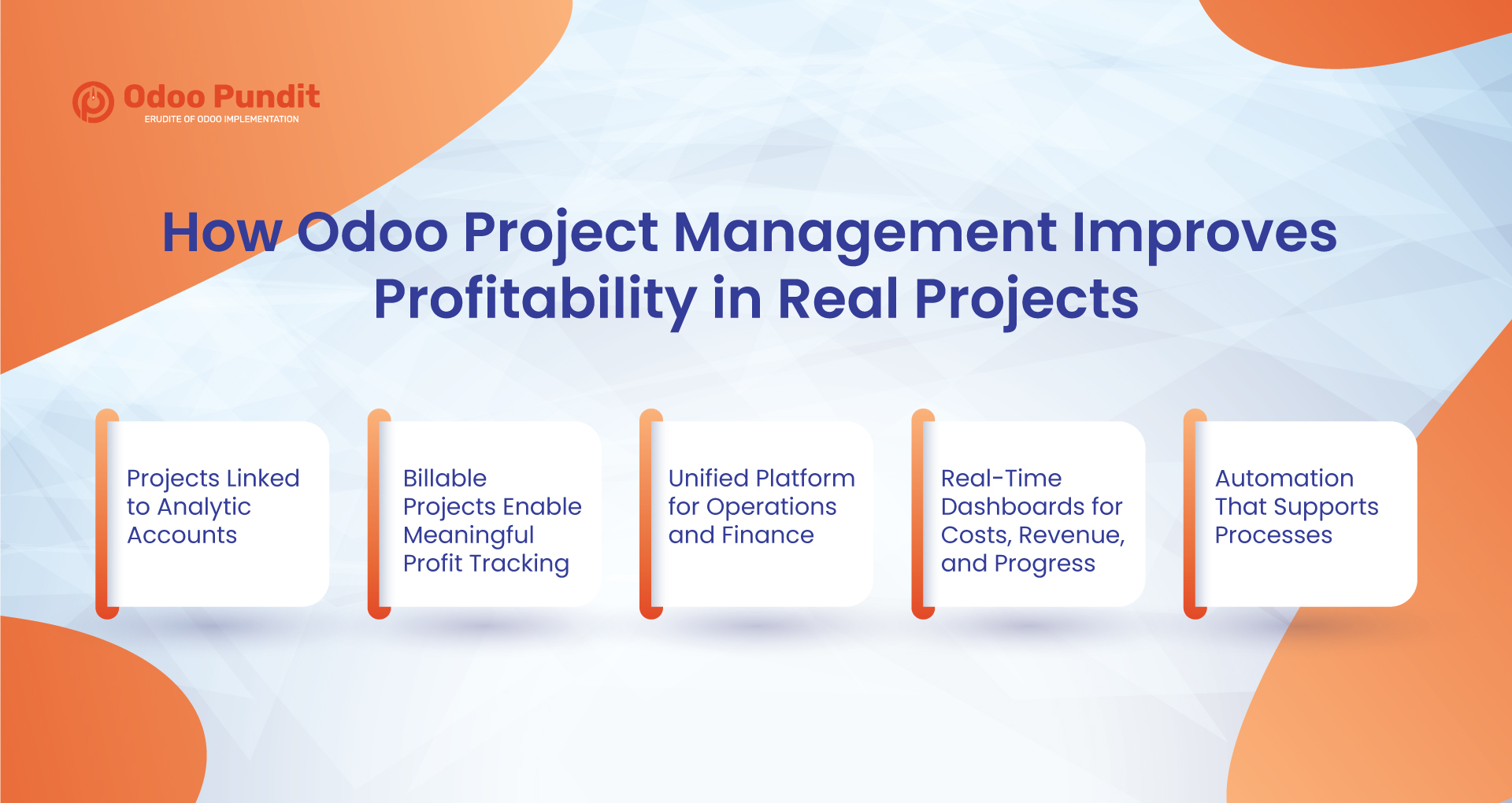
How Odoo Project Management Improves Profitability in Real Projects
Odoo’s strength lies in how daily project activity feeds directly into financial tracking through analytic accounting and sales integration.
Projects Linked to Analytic Accounts
Each customer project is associated with an analytic account, a financial container that collects both project costs and revenue. Labor costs from timesheets, employee expenses, and vendor bills accumulate here when properly assigned. Revenue from customer invoices associated with the same analytic account also contributes, enabling margin analysis in one place. Re-invoiced expenses and billable items further update this financial picture.
Organizations undertaking an Odoo implementation often discover that analytic accounting is the foundation of reliable project profitability reporting.
Billable Projects Enable Meaningful Profit Tracking
Profitability dashboards are most useful for projects delivered to customers under contract. These projects are typically linked to sales orders, allowing the system to analyze revenue alongside costs and calculate margins throughout the lifecycle.
Unified Platform for Operations and Finance
Tasks, timesheets, expenses, purchase orders, vendor bills, budgets, and invoices all reside in one environment. Once configured, this integration reduces manual reconciliation and ensures consistent information across departments.
Real-Time Dashboards for Costs, Revenue, and Progress
Managers can monitor key indicators such as:
- Logged hours versus planned effort
- Approved expenses and vendor costs
- Budget consumption
- Revenue from project-related invoices
- Task completion status
- Estimated margins
This visibility enables proactive decisions rather than retrospective analysis.
Automation That Supports Processes
Reminders for missing timesheets, approval notifications, and invoice preparation can be automated. However, these workflows depend on proper configuration and clearly defined business rules.
How Accurate Time Tracking Directly Increases Service Profitability
In service organizations, labor is usually the largest cost component. Measuring it accurately improves billing precision, planning accuracy, and operational efficiency.
Task-Level Time Tracking
Employees record time against specific tasks within a project. This granularity reveals where effort is actually spent and highlights inefficiencies or rework.
Planned vs Actual Hours for Capacity Control
Planning tools allow teams to assign expected hours to tasks or individuals. Comparing planned versus actual time highlights overruns early and improves future estimates.
Separation of Billable and Non-Billable Work
Time entries can be categorized according to billing rules defined in sales configurations. Even non-billable work provides insight into overhead and supports more accurate pricing.
Preventing Underbilling Through Sales Integration
Time-based billing typically relies on a sales order linked to the project. Service products configured for timesheet billing allow approved hours to be invoiced according to contractual terms. Without this linkage, time tracking alone does not produce revenue.
Data-Driven Resource Planning
Historical timesheet data helps organizations answer important operational questions:
- How long do similar tasks really take?
- Which teams deliver most efficiently?
- Where do projects consistently overrun?
- When is additional hiring justified?
Over time, this data leads to more reliable pricing and scheduling.
Controlling Project Costs with Purchasing, Vendors, and Budgets
Many service projects depend on external suppliers, subcontractors, or materials. Managing these costs is essential for accurate profitability analysis.
Assigning Purchases to Projects via Analytic Accounts
Purchase orders and vendor bills can reference the project’s analytic account. Costs contribute to project totals once supplier invoices are confirmed, posted, and properly assigned.
Tracking Vendor Expenses in Real Time
As supplier invoices are recorded, project costs update immediately. Managers no longer need to wait for month-end reports to understand spending levels.
Managing Subcontractors and External Services
External contributors can be tracked through procurement workflows, expense entries, or service purchases tied to the project’s analytic account. Organizations with complex requirements sometimes use Odoo customization services to align tracking with their delivery model.
Using Budgets to Control Spending
Analytic budgets can be defined to compare planned versus actual expenses. This allows early detection of overspending and supports corrective action before margins deteriorate.
Re-Invoicing Project Expenses to Clients
Certain costs can be passed on to customers if configured in sales settings. When reinvoicing is enabled, these expenses appear on customer invoices and contribute to project revenue rather than reducing margin.
Preventing Budget Overruns Early
With expenses tied to analytic accounts and budgets, leaders can renegotiate scope, adjust resources, or control additional purchases before problems escalate.
Approval Workflows That Protect Margins
Structured approvals introduce financial discipline without excessive bureaucracy.
- Purchase approvals: Prevent unauthorized spending
- Timesheet approvals: Ensure hours align with project scope
- Expense approvals: Control reimbursements and travel costs
These controls improve accuracy without slowing delivery when designed correctly.
Automation That Reduces Administrative Overhead
Administrative tasks consume valuable time that could otherwise be billable.
Automated Reminders and Notifications
Users receive prompts for pending approvals or missing timesheets, improving data completeness without manual follow-up.
Invoice Preparation from Project Data
When billable hours or milestones accumulate, invoices can be generated using approved time and expenses tied to the relevant sales order. Finance teams review before issuing them, reducing errors and delays.
Cross-Department Coordination
Operations, procurement, and finance teams work from shared data, minimizing miscommunication and duplication.
Real-World Use Cases Where Odoo Delivers the Most Value
Integrated project management delivers significant benefits across professional services sectors:
- IT and software implementation firms: Long engagements with evolving requirements
- Engineering and consulting services: Complex projects requiring precise cost control
- Marketing and creative agencies: High volumes of revisions and client interactions
- Field service organizations: Travel, materials, and subcontractor involvement
In each case, accurate tracking ensures projects remain commercially viable.
Best Practices for Successful Adoption
Technology alone does not guarantee results. Clear processes are essential.
- Establish consistent time tracking policies
- Configure analytic accounting carefully
- Link projects to sales orders for billing
- Use budgets as control mechanisms
- Balance approval rules
- Review historical project data regularly
Organizations that implement time tracking without clear policies often struggle with low adoption and unreliable data.
Is Odoo Project Management Right for Your Organization?
Integrated project tracking becomes especially valuable when:
- Projects span multiple teams or long durations
- External vendors play a major role
- Billing depends on accurate time reporting
- Profitability varies significantly between projects
- Leadership lacks real-time insight
Many growing firms adopt ERP-based project management after outgrowing spreadsheets and disconnected tools.
Conclusion: From Guesswork to Controlled Profitability
Odoo project management improves service profitability by bringing time tracking, cost control, purchasing, budgeting, and billing into one connected system that delivers real-time margin visibility.
Profit rarely disappears overnight, it erodes through untracked effort, unmanaged expenses, and delayed insight. By unifying operational and financial data around projects, organizations can understand true delivery costs while work is still in progress.
If your teams are busy but margins remain unclear, reviewing your current workflows can reveal hidden inefficiencies. Even small improvements in tracking accuracy and cost control can lead to meaningful financial gains without increasing workload or sales pressure.
Not sure where your projects are losing margin? Let’s find out.
Get a practical review of your current project workflows, billing accuracy, and cost visibility — and see where hidden revenue leakage may be occurring.
FAQs
Odoo tracks profitability by aggregating revenue and costs linked to a project’s analytic account, including labor, expenses, purchases, and vendor bills.
Yes. When timesheets are linked to a sales order configured for time-based billing, approved hours can be converted into customer invoices.
Yes. Odoo is widely used by professional services organizations that bill based on time, deliver projects, and require integrated cost tracking.
Yes. Vendor bills, purchase orders, and expenses can be assigned to projects, allowing external costs to be included in profitability calculations.