Educational institutions today operate like complex service organizations. Admissions resemble sales pipelines, academic delivery requires structured operations, finance teams manage recurring revenue streams, and alumni relations demand long-term engagement. Yet many schools, colleges, and training providers still rely on disconnected systems that create inefficiencies and poor visibility.
Odoo for Education offers a unified digital foundation to manage the entire student journey, from first inquiry to alumni engagement, when configured with the right mix of native applications, education modules from the Odoo Apps Store, and partner-led customization. Rather than a prebuilt campus system, Odoo is a flexible enterprise platform that can be adapted into a comprehensive education ERP aligned to institutional processes.
This guide explains what Odoo can realistically do for educational organizations, how it compares to traditional Student Information Systems, and when it is the right fit.
Key Takeaways
- Odoo is not a native education ERP but a configurable enterprise platform
- Core modules manage admissions, finance, communication, and operations
- Academic features come from education-specific add-ons or custom modules
- Ideal for institutions needing integration across departments or campuses
- Especially valuable for organizations pursuing digital transformation
What Is Student Lifecycle Management in Education?
Student lifecycle management is the process of managing all interactions with a learner from initial inquiry through enrollment, academic progress, graduation, and alumni engagement.
Instead of siloed departments, it creates a connected ecosystem where data flows continuously across functions.
Key Stages of the Student Lifecycle
Most institutions manage six major phases:
- Prospect inquiry and recruitment
- Admissions and enrollment
- Academic delivery and progress tracking
- Financial management and fee collection
- Graduation processes
- Alumni engagement
A unified platform eliminates repeated data entry and reduces errors across these stages.
Why Traditional Systems Fall Short
Many legacy student information systems focus only on academic records, while separate tools handle recruitment, finance, communication, and learning management.
Common problems include:
- Data silos across departments
- Manual reconciliation of payments
- Limited real-time visibility
- Slow reporting cycles
- Inconsistent student experience
An integrated education ERP platform addresses these issues by maintaining a single source of truth.
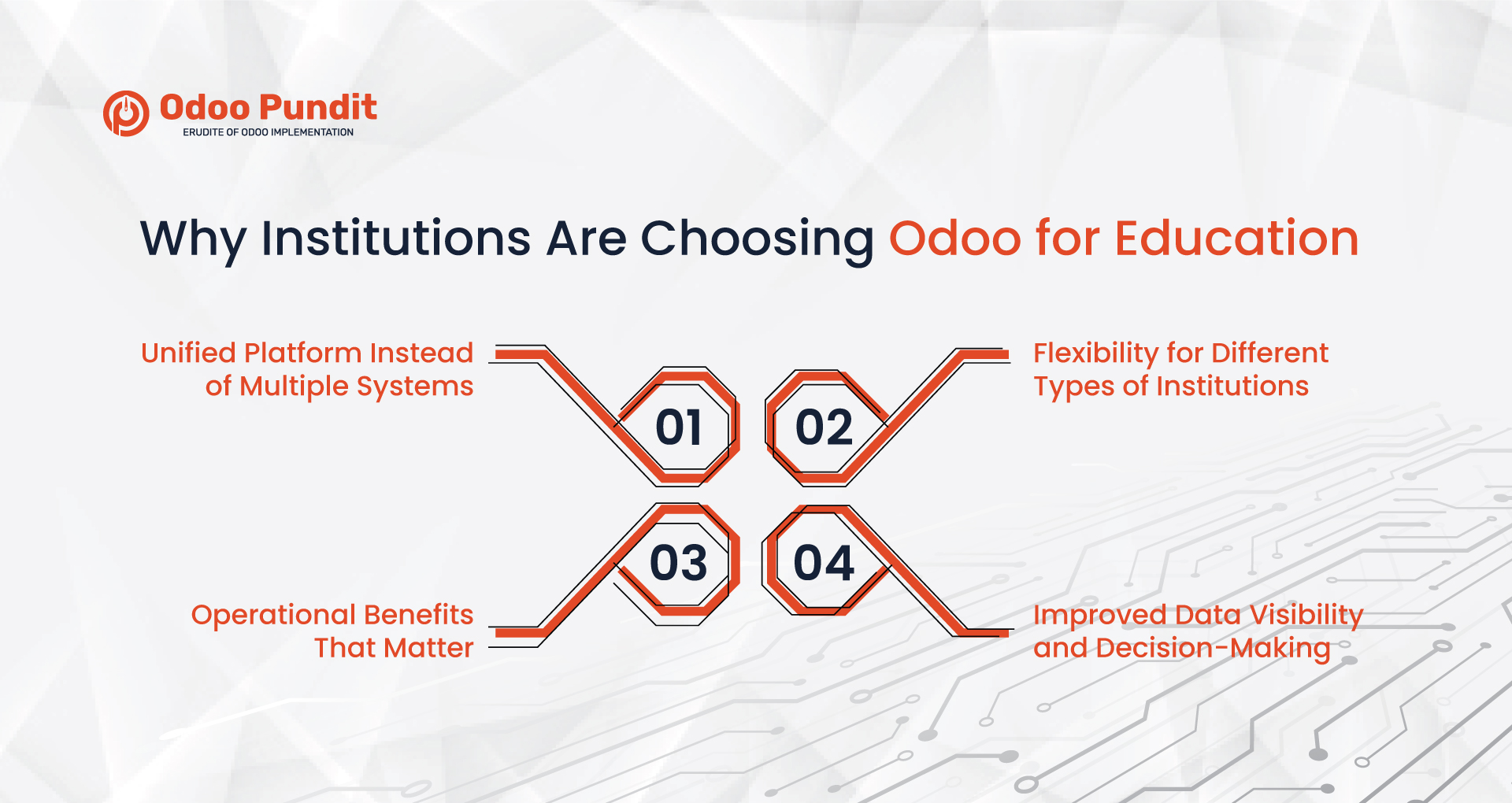
Why Institutions Are Choosing Odoo for Education
Educational organizations increasingly seek scalable, cost-effective software that supports growth without locking them into rigid systems. Odoo for Education is gaining traction because it combines multiple enterprise capabilities into one modular ecosystem.
Odoo is not a dedicated campus management system out of the box. Instead, it provides a business platform on which education-specific solutions can be built.
Unified Platform Instead of Multiple Systems
Odoo includes core applications such as:
- CRM for admissions and recruitment
- Accounting and invoicing
- Human resources and payroll (in supported regions or via partners)
- Website builder and online forms
- Marketing automation
- Document management
- Helpdesk and communication tools
- eLearning platform
- Internal collaboration tools
Education-specific functions, including student records, timetables, attendance, and exams, are typically delivered through specialized modules.
Because all applications share one database, information flows automatically. For example, when a prospect enrolls, their communication history and financial data remain connected.
Flexibility for Different Types of Institutions
Odoo’s modular architecture supports:
- Schools and K-12 institutions
- Colleges and universities
- Training centers and academies
- Multi-campus organizations
Its multi-company capability allows centralized oversight while maintaining separate records for each campus. Role-based access ensures appropriate visibility for administrators, faculty, students, parents, and alumni.
Operational Benefits That Matter
Institutions typically aim to achieve:
- Reduced administrative workload
- Improved data accuracy
- Faster reporting
- Better cross-department coordination
- Scalable digital infrastructure
However, results depend on process alignment and proper implementation.
Improved Data Visibility and Decision-Making
With all data in one system, leadership can monitor admissions pipelines, fee collections, program performance, and operational bottlenecks in real time. Central dashboards enable evidence-based decisions, especially valuable for multi-campus institutions or rapidly changing enrollment patterns.
Admissions and Enrollment Management
Recruitment and admissions are critical functions where efficiency directly impacts revenue and student experience.
Inquiry Capture and Lead Management
Odoo CRM manages prospective students as contacts and opportunities. Inquiries from websites, events, and campaigns flow into a centralized pipeline, allowing teams to track each applicant’s progress.
Automated reminders help maintain engagement without manual follow-ups.
Application Processing and Documentation
While Odoo does not include a native admissions module, document management tools store application files securely, and workflows route submissions for review. Education modules handle eligibility checks, selection processes, and status tracking.
Enrollment Confirmation and Onboarding
Once accepted, applicants can be converted into enrolled students. Billing schedules, portal access, and program assignments activate automatically, reducing administrative effort during peak periods.
Academic Management and Student Information Capabilities
Odoo does not provide a built-in Student Information System. Instead, SIS functionality is achieved through education-specific modules integrated with the platform.
Institutions can manage:
- Programs and courses
- Batches and schedules
- Attendance tracking
- Assessments and grading
- Academic records
Faculty can update performance data directly, enabling real-time progress monitoring.
Student Self-Service Portal
Odoo’s portal framework provides role-based access for students and parents. With appropriate modules, users can view schedules, attendance, grades, fee statements, notifications, and service requests.
This reduces administrative workload while improving transparency.
Fees, Billing, and Financial Operations
Financial management is one of Odoo’s strongest areas.
Institutions can automate tuition structures, installment plans, and invoicing based on programs or terms. Online payments integrate with accounting, enabling automatic reconciliation.
Scholarships, discounts, and sponsorships can be tracked with full audit trails. Multi-currency support and detailed reporting make the system suitable for institutions operating across regions.
Communication, Engagement, and Student Services
Effective communication significantly influences student satisfaction.
Odoo enables automated notifications for deadlines, payments, and events. The helpdesk application can be adapted for student support, allowing requests to be tracked from submission to resolution.
Events and activities can be organized centrally with online registration, ensuring consistent communication across departments.
eLearning and Digital Course Delivery
Odoo includes a native eLearning platform for delivering online courses and training programs.
Institutions can:
- Publish course content
- Upload videos and documents
- Conduct quizzes and assessments
- Track learner progress
- Issue certificates
- Offer paid programs
The eLearning app is particularly useful for blended learning and professional training. Institutions with complex academic requirements may still integrate specialized LMS platforms.
Alumni Management and Long-Term Engagement
Maintaining relationships after graduation supports reputation and fundraising efforts.
Alumni can remain in the system as contacts, allowing segmentation by program, year, or engagement level. CRM and marketing tools support newsletters, events, and donation campaigns.
Reporting and Decision Support
Odoo provides real-time dashboards across admissions, finance, and operations. Leadership can monitor performance without waiting for manual reports.
Built-in spreadsheet tools allow dynamic reporting connected directly to live data, improving forecasting accuracy and planning.
Odoo vs Traditional Student Information Systems
Traditional SIS platforms often specialize in academic records but lack broader enterprise capabilities.
Maintaining multiple systems increases licensing costs, integration challenges, and data fragmentation. A unified ERP can reduce complexity but requires careful planning and customization.
Odoo’s open architecture supports gradual expansion as institutional needs evolve, while a consistent interface simplifies training and adoption.
Real-World Use Case: Unifying Operations Across Multiple Campuses
A multi-campus institution offering academic and professional programs struggled with disconnected tools across admissions, finance, and academics.
After implementing Odoo as a centralized platform:
- All inquiries entered a single admissions pipeline
- Applications were processed digitally
- Billing workflows activated automatically upon acceptance
- Online payments reduced reconciliation delays
- Each campus maintained financial independence
- Leadership accessed consolidated dashboards
Within one academic cycle, the institution achieved faster admissions processing, improved fee visibility, and more accurate enrollment forecasting.
This demonstrates how Odoo connects processes across departments rather than acting as a preconfigured school system.
When Odoo May Not Be the Best Fit
Odoo is powerful but not ideal for every institution.
It may be less suitable for:
- Very small organizations with simple workflows
- Institutions requiring a turnkey SIS with no customization
- Organizations dependent on highly specialized academic systems
In such cases, dedicated education software may be more appropriate.
Is Odoo for Education Right for Your Institution?
Odoo delivers the greatest value when institutions face operational complexity across departments or campuses.
It is particularly suitable for organizations seeking centralized visibility, scalable processes, and integrated operations while retaining flexibility.
Successful deployments require stakeholder alignment, process standardization, and staff training.
Conclusion: A Smarter Approach to Managing the Student Journey
Educational institutions face increasing pressure to improve efficiency while delivering exceptional student experiences. Fragmented systems hinder visibility and slow decision-making.
Odoo for Education provides a configurable enterprise foundation that can unify admissions, academics, finance, and engagement across the entire student lifecycle. When implemented strategically, it enables institutions to streamline operations, improve communication, and make data-driven decisions.
Ultimately, success depends on aligning technology with institutional goals and processes, not simply adopting new software.
For schools, universities, and training providers seeking a scalable path to digital transformation, evaluating Odoo as an education ERP platform can be a practical and future-ready step forward.
Considering Odoo for your institution
Get expert guidance to evaluate whether a unified ERP approach fits your campus operations, goals, and growth plans, before making a major technology decision.