Healthcare organizations are operating in an environment where compliance expectations are increasing while operational margins are tightening. Managing patient data securely, coordinating teams across departments, and maintaining regulatory readiness have become just as critical as delivering quality care.
To address these challenges, many healthcare providers are re-evaluating their technology stack. Instead of relying on disconnected systems, they are turning to ERP platforms that bring structure, visibility, and scalability. Odoo for healthcare is emerging as a practical choice for organizations seeking a flexible ERP foundation that supports compliance, workflow automation, and operational efficiency, without the rigidity of traditional healthcare software.
The Growing Compliance and Efficiency Challenges in Healthcare
Healthcare operations sit at the intersection of data sensitivity and process complexity. Providers must manage patient records, billing, inventory, staffing, and reporting while meeting strict regulatory expectations.
Common challenges include:
- Maintaining healthcare regulatory compliance across departments
- Protecting sensitive patient data using secure healthcare information systems
- Managing audits, approvals, and access controls manually
- Operating with fragmented software that slows down workflows
When finance, HR, inventory, and patient administration systems operate in silos, compliance becomes harder to enforce, and inefficiencies multiply. This is why many organizations are exploring ERP for healthcare compliance and healthcare compliance software, not as a clinical system replacement, but as a centralized operational backbone that supports governance, audit readiness, and secure operations.
Why Odoo for Healthcare Is a Strategic ERP Choice
Odoo is not a healthcare-only product, and that is precisely its strength. As an enterprise ERP platform, it is designed to manage complex business operations across industries. When applied correctly, Odoo for healthcare becomes a powerful system for coordinating administrative and operational workflows.
As a hospital management ERP foundation, Odoo enables:
- Centralized financial, HR, inventory, and operational management
- Real-time visibility across departments
- Modular scalability for clinics, hospitals, and healthcare groups
Odoo’s modular structure allows healthcare organizations to implement only what they need and expand over time. This makes it especially suitable for providers navigating digital healthcare management without committing to rigid, all-or-nothing systems.
Understanding Compliance: What Odoo Supports and What It Doesn’t
It’s important to clarify how compliance works with ERP platforms. Odoo is not a pre-certified healthcare compliance solution. However, it provides the technical capabilities required to support compliant healthcare environments when configured correctly.
Odoo includes features such as:
- Role-based access control to limit data exposure
- Audit trails that log changes and user actions
- Structured data management aligned with medical data compliance standards
- Secure deployment options suitable for healthcare IT solutions
When properly implemented, these capabilities allow organizations to build a HIPAA-aligned ERP environment from a technical perspective, subject to organizational policies and regulatory validation. Compliance ultimately depends on configuration, internal policies, governance, and hosting decisions, not software alone.
Healthcare Workflow Automation with Odoo
Manual processes are one of the biggest barriers to efficiency in healthcare operations. Administrative bottlenecks increase staff workload and raise the risk of errors. This is where healthcare workflow automation delivers real value.
Odoo supports healthcare process automation across non-clinical functions, helping teams work faster and more consistently.
Automating Clinical and Administrative Workflows
Using Odoo, healthcare organizations can automate:
- Appointment and resource scheduling
- Billing approvals and invoicing workflows
- Inventory and medical supply tracking
- HR processes such as onboarding, payroll, and attendance
By reducing manual intervention, teams can focus more on patient care while maintaining operational control. This structured approach improves coordination across clinical and administrative workflows without overcomplicating daily tasks.
Improving Healthcare Operations Efficiency with Odoo ERP
Operational efficiency is not just about cost reduction; it’s about visibility and control. With ERP for hospital operations, decision-makers gain access to real-time insights across the organization.
Odoo enables:
- Centralized dashboards for finance, operations, and HR
- Accurate reporting for audits and internal reviews
- Reduced duplication of data and effort
- Better forecasting and resource planning
This level of transparency supports healthcare business process optimization and allows leadership teams to respond quickly to operational and regulatory changes.
Odoo Hospital Management System: Real-World Use Cases
Odoo does not function as a complete hospital management system out of the box. Instead, it becomes one when extended with healthcare-specific modules available in the Odoo ecosystem or through custom development. Clinical functions such as EMR, patient history, and lab workflows are delivered through these healthcare modules rather than the core ERP.
Hospitals
Large hospitals benefit from Odoo’s ability to unify departments such as finance, procurement, HR, and facilities. As an Odoo hospital management system foundation, it supports multi-department coordination while allowing healthcare-specific modules to handle patient records and clinical data where required.
Clinics and Diagnostic Centers
Smaller healthcare providers often need efficiency without unnecessary complexity. Odoo ERP solutions for hospitals and clinics help streamline administrative workflows, manage inventory, and maintain compliance readiness while remaining scalable as patient volumes grow.
Odoo ERP Customization for Healthcare Organizations
Healthcare workflows are rarely standardized. Regulations, internal policies, and service models vary widely. This is why Odoo ERP customization for healthcare is essential for success.
With the right configuration, Odoo can:
- Align workflows with organizational policies
- Integrate with existing patient data management systems
- Support electronic health records integration through APIs, middleware, or specialized healthcare connectors, including custom or third-party connectors aligned with healthcare data standards.
- Adapt reporting structures to regulatory expectations
Partnering with experienced teams for Odoo customization services ensures the system reflects real operational needs instead of forcing healthcare staff to adapt to rigid software processes.
The Role of Implementation in Healthcare ERP Success
ERP projects in healthcare require careful planning. Data sensitivity, operational continuity, and compliance expectations leave little room for error.
A structured Odoo implementation approach helps organizations:
- Define clear compliance and security requirements
- Configure access controls and audit mechanisms
- Integrate existing systems without disruption
- Train teams effectively for long-term adoption
Successful implementations focus as much on process alignment as they do on technology.
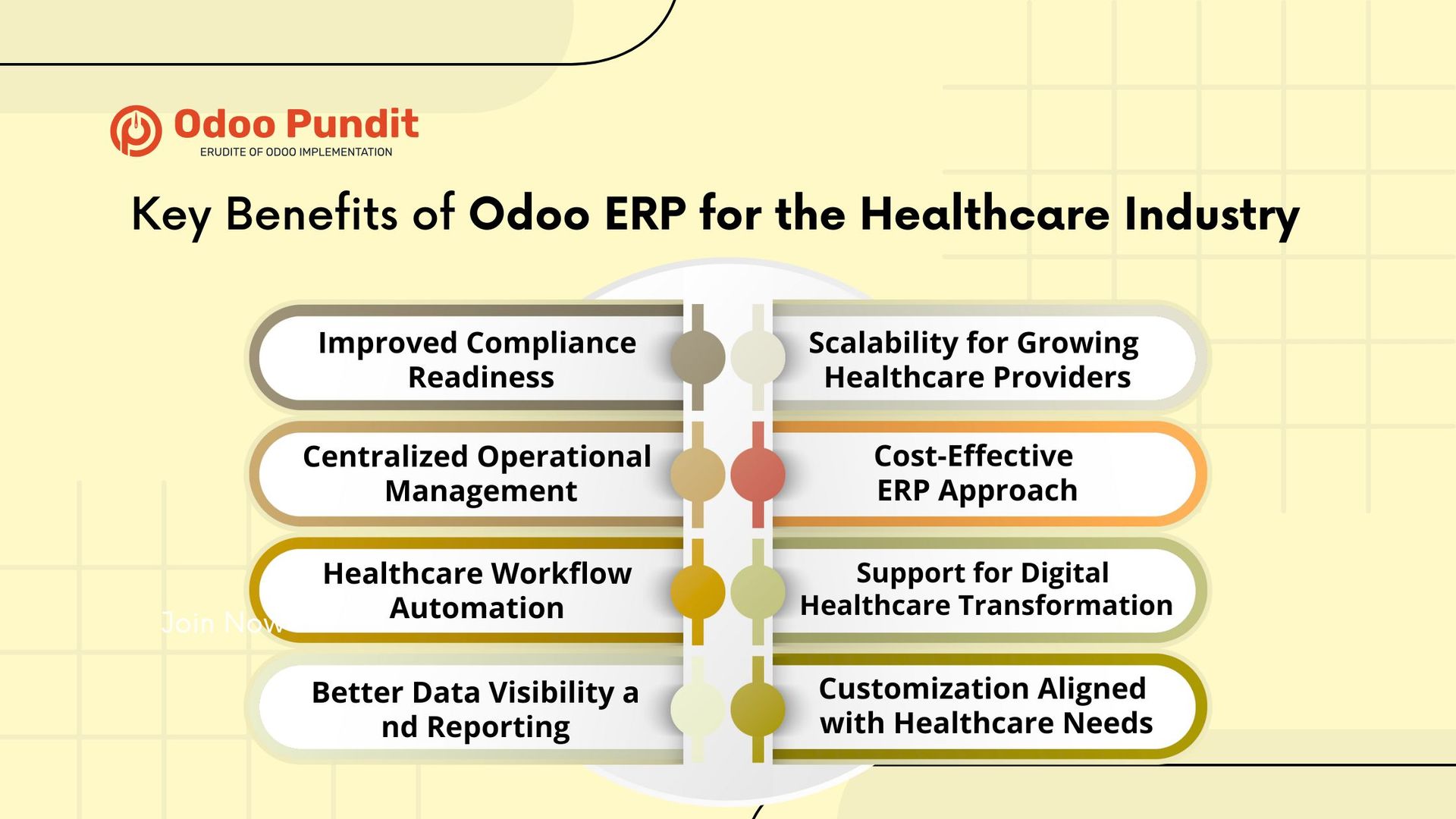
Key Benefits of Odoo ERP for the Healthcare Industry
When deployed strategically, Odoo delivers measurable value across healthcare operations by strengthening compliance readiness, improving visibility, and simplifying day-to-day management.
- Improved Compliance Readiness
Odoo supports structured data management, access controls, and audit trails that help healthcare organizations maintain better oversight of regulatory requirements and internal governance processes. - Centralized Operational Management
By bringing finance, HR, inventory, and administration into a single system, Odoo reduces data silos and enables smoother coordination across departments. - Healthcare Workflow Automation
Routine administrative tasks such as billing approvals, scheduling, and inventory updates can be automated, reducing manual effort and minimizing the risk of errors. - Better Data Visibility and Reporting
Real-time dashboards and configurable reports give leadership teams timely insights into operational performance, costs, and resource utilization. - Scalability for Growing Healthcare Providers
Odoo’s modular architecture allows healthcare organizations to start with essential features and scale gradually as operations expand or service models evolve. - Cost-Effective ERP Approach
Compared to traditional healthcare ERP systems, Odoo offers a flexible and budget-conscious platform that balances functionality with long-term maintainability. - Support for Digital Healthcare Transformation
Odoo acts as a strong ERP foundation for healthcare digital transformation by enabling system integration, process standardization, and future technology adoption. - Customization Aligned with Healthcare Needs
The platform can be tailored to match specific healthcare workflows, compliance requirements, and reporting structures without forcing organizations into rigid software models.
How Odoo Helps Healthcare Organizations Improve Efficiency and Compliance
Understanding how Odoo helps healthcare organizations improve efficiency comes down to integration. When finance, HR, inventory, and operations share a single system, compliance becomes easier to manage, and inefficiencies become easier to identify.
By using Odoo for healthcare compliance management, organizations reduce reliance on spreadsheets and disconnected tools. This structured approach supports consistent governance while enabling teams to work more efficiently and confidently.
Final Thoughts
Healthcare organizations need systems that are flexible, transparent, and built for long-term sustainability. Odoo for healthcare offers a realistic ERP foundation, one that supports compliance, improves operational efficiency, and adapts to evolving healthcare demands without locking organizations into rigid software structures.
For providers seeking a future-ready ERP approach, Odoo delivers the balance of control, scalability, and adaptability that modern healthcare operations require.
Ready to streamline healthcare operations and stay audit-ready?
Explore Odoo ERP solutions today.
Your Site Title
Yes. Odoo is an enterprise healthcare software platform that, when extended with healthcare-specific modules and configured correctly for operational and compliance needs.
Odoo provides the technical controls required to support a HIPAA-aligned ERP environment, but compliance ultimately depends on configuration, policies, governance, and operational practices.
No. EMR and patient record management are delivered through healthcare modules or custom development, not the core Odoo installation.
Yes. Odoo supports electronic health records integration and other system connections through APIs, middleware, and third-party healthcare modules.
Absolutely. Odoo ERP solutions for hospitals and clinics are designed to scale with organizational growth and operational complexity.