Property management looks simple on paper leases go out, rent comes in, expenses get paid. In reality, once portfolios grow beyond a handful of units, things get messy fast. Lease renewal dates are missed, invoices are sent late, vendor bills pile up, and finance teams spend more time reconciling data than making decisions.
This is where Odoo for Property Management starts to matter. Not as another system to maintain, but as a structured ERP foundation that when combined with purpose-built property management apps connects leases, rental invoicing, purchasing, and approvals into a single operational view.
For teams already feeling the strain of manual work or disconnected tools, understanding how Odoo supports these workflows can be the difference between reactive operations and controlled, scalable growth.
This guide explains how lease renewals and rental invoicing work in Odoo in practice, including where app-based extensions are required and what property teams should realistically expect when using Odoo as an ERP for property management.
The Real Challenges Behind Lease Renewals and Rental Invoicing
Most property teams don’t struggle because they lack effort. They struggle because their systems don’t scale with portfolio growth.
As portfolios expand, teams typically encounter the following issues:
- Lease renewals tracked in spreadsheets or email threads
- Manual rental invoicing recreated every billing cycle
- No clear connection between lease terms and billed amounts
- Security deposits and utility charges handled outside the main system
- Maintenance costs and vendor bills disconnected from rental income
- Approval bottlenecks across finance, operations, and management
Individually, these problems seem manageable. Together, they create operational drag, billing disputes, and reduced financial visibility especially when teams rely on multiple tools that don’t talk to each other.
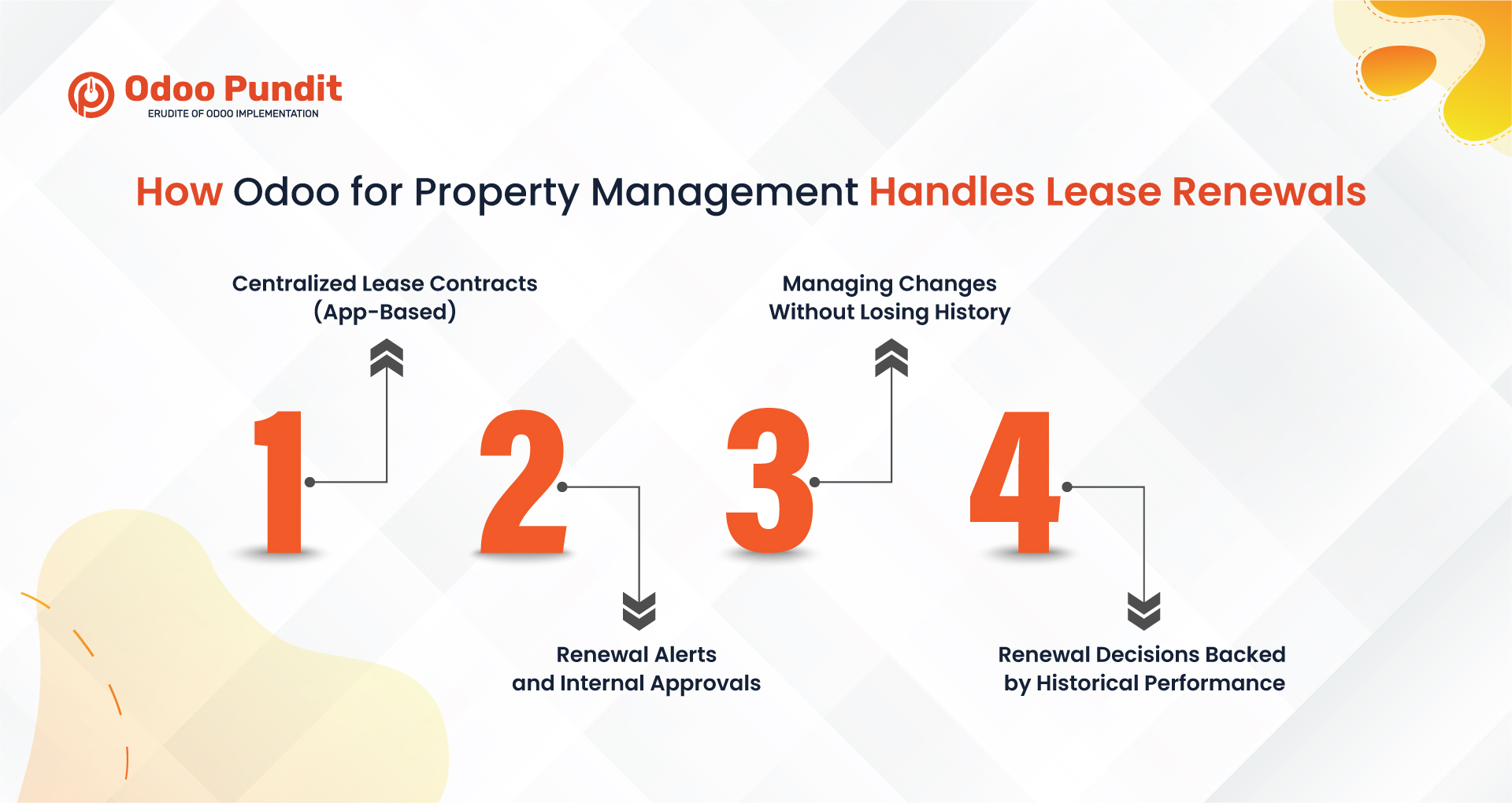
How Odoo for Property Management Handles Lease Renewals
Lease renewals in Odoo are managed through property leasing apps that extend core ERP capabilities, allowing teams to control the full lease lifecycle from creation to renewal within a structured system.
These apps build on Odoo’s accounting, approvals, and automation framework to support real-world property workflows.
Centralized Lease Contracts (App-Based)
Property leasing apps introduce structured lease records that include:
- Tenant and unit details
- Lease start and end dates
- Rent amount and billing frequency
- Escalation rules and renewal terms
- Security deposits or advance payments
Because this information is stored as structured data not just documents, it becomes operationally useful. Teams don’t need to remember what’s in a lease; the system references it directly during billing, renewals, and reviews.
Renewal Alerts and Internal Approvals
Lease expiry alerts are generated automatically based on contract dates, giving teams time to plan renewals instead of scrambling at the last moment.
Changes such as rent increases or term extensions can follow internal approval workflows. In day-to-day operations, this ensures finance, operations, and management review updates before they are finalized reducing errors and miscommunication.
Managing Changes Without Losing History
Leases evolve. Extensions, amendments, and terminations are handled without overwriting prior data. Historical versions remain available, which proves valuable during audits, tenant discussions, and long-term performance analysis.
Renewal Decisions Backed by Historical Performance
Because lease records are linked to invoices and payments, teams can review a tenant’s payment behavior and past adjustments before renewing. In practice, this allows renewal decisions to be based on facts rather than assumptions such as whether escalations are justified or revised terms are needed.
Rental Invoicing That Matches Lease Terms
Rental invoicing in Odoo is driven by recurring billing mechanisms linked directly to lease data, reducing manual effort and improving accuracy across billing cycles.
Automated Recurring Rental Invoices
Once a lease is active, rental invoices are generated automatically based on defined schedules monthly, quarterly, or custom. This recurring billing approach removes the need to recreate invoices manually and lowers the risk of missed billing periods.
As a result, teams see:
- Fewer missed invoices
- Consistent billing aligned with contracts
- Less manual follow-up
Proration, Adjustments, and Exceptions
Property billing rarely follows perfect cycles. Mid-month move-ins, rent revisions, credits, and early terminations are common.
Odoo supports prorated invoices and documented adjustments, ensuring each change is traceable and reflected correctly in accounting, something finance teams rely on during reconciliations.
Utility and Maintenance Charges
Many property apps also support common industry billing requirements, such as:
- Utility billing (electricity, water, gas)
- Maintenance charges based on unit size (sqft or sqm)
- Additional service fees linked to the lease
This ensures tenants receive a consolidated, transparent bill instead of fragmented charges from multiple systems.
One-to-One Traceability Between Lease Terms and Invoices
Each invoice can be traced back to the lease rule that generated it. This traceability simplifies tenant queries, speeds up dispute resolution, and keeps records audit-ready. For finance teams, it reduces back-and-forth and improves confidence in reported figures.
Tenant Portals and Maintenance Coordination
Modern property operations benefit from transparency on both sides.
Many Odoo property apps provide tenant portals where tenants can:
- View lease contracts and invoices
- Track outstanding payments
- Submit maintenance requests
Maintenance requests can flow directly into internal workflows, triggering tasks or vendor requests without manual coordination. In practice, this improves response times while giving operations teams better visibility into ongoing issues.
Purchasing, Vendors, and Approvals in Property Operations
Rental income is only half the picture. Ongoing expenses maintenance, utilities, and services must be controlled just as carefully.
Property-Related Purchasing in One Place
Odoo allows teams to manage purchase requests and orders related to property operations within the same ERP system that tracks rental income.
This helps teams answer practical questions such as:
- What are we spending per property or unit?
- Which vendors cost the most over time?
- How do operating costs compare to rental revenue?
Approval Workflows That Fit Real Teams
Approval rules can be defined based on value, category, or role. Smaller expenses move quickly, while higher-value purchases receive appropriate oversight. This balance reduces delays without sacrificing control.
Vendor Bills and Financial Alignment
Vendor invoices are matched with approved purchases and posted directly into accounting. Over time, this improves cost visibility, reduces reconciliation effort, and strengthens operational visibility across the portfolio.
Practical Benefits for Property Management Teams
When lease management, invoicing, purchasing, and maintenance live in one system, the benefits compound.
Property teams typically experience:
- Less manual coordination between operations and finance
- Fewer billing disputes due to consistent data
- Better forecasting with income and expenses in one view
- Improved compliance through approvals and audit trails
These aren’t overnight transformations. They are steady improvements that reduce daily friction and support long-term scalability.
When Odoo Is a Strong Fit and When It Needs Thoughtful Setup
Odoo works best for property teams that value structure and are willing to align their processes.
Where Odoo Fits Well
- Growing property portfolios
- Teams managing rental income and operational costs together
- Organizations that need flexibility beyond rigid, off-the-shelf tools
Where Care Is Needed
Odoo is not a plug-and-play property management system. Property workflows rely on app-based extensions and configuration, which makes a structured Odoo implementation essential. Mapping real processes before configuration is key to long-term success.
For organizations with complex lease rules, custom billing logic, or regional compliance needs, selective Odoo customization services help bridge gaps without overengineering the system.
Final Thoughts: Building Calm, Scalable Property Operations
Property management doesn’t need more tools; it needs better-connected ones.
Odoo for Property Management, when paired with the right property leasing apps, offers a structured way to manage leases, rental invoicing, vendor costs, maintenance, and approvals within a single ERP environment.
The real value isn’t in features alone, but in visibility. When operations and finance work from the same data, decisions become clearer, risks are easier to spot, and growth feels manageable.
If you’re looking to reduce complexity and gain control as your portfolio expands, understanding how Odoo fits into your actual workflows is a practical place to begin.
See whether it fits your property management workflows before making any system changes.
FAQs
Yes. Property leasing apps support different contract types, billing frequencies, and escalation models commonly used in residential and commercial properties.
Rental invoicing is automated using recurring billing mechanisms linked to lease data. Renewals are supported through expiry alerts and structured updates.
Approval workflows can be configured based on amount, category, or role, helping teams balance speed with financial control.
Yes, provided processes are clearly defined. As portfolios grow, centralized data becomes increasingly valuable.
Yes. Lease, invoicing, purchasing, maintenance, and accounting data all flow through the same ERP framework.