In many textile warehouses, the problem doesn’t start with dyeing. It starts at the rack.
Two rolls look the same. Same fabric. Same color. Same supplier. One is issued to production. Hours later, the shade doesn’t match yesterday’s batch. Work stops. The store says, “It’s the same lot.” Production says, “It’s not.”
This issue is often searched as “dye lot mix up,” “fabric shade difference problem,” or “how to track dye batches in textile inventory.” It’s also one of the most common reasons for shade variation complaints, buyer rejections, and production delays in textile units.
This is where Odoo for textile inventory control changes the story, not by adding more supervision, but by changing how fabric lots and dye batches are recorded, scanned, and traced from the moment they enter the warehouse.
This article explains why these mix-ups happen so often and how a correctly configured Odoo workflow removes the root cause.
What Is a Dye Lot in Textile Inventory?
A dye lot is a batch of fabric dyed together under the same process conditions. Even when the color and fabric type are the same, two dye lots can have slight shade variations.
In textile inventory, tracking dye lots separately is critical to ensure shade consistency during production and to maintain traceability during audits and quality checks.
The Real Warehouse Problem Textile Teams Don’t Talk About
If you walk into most textile stores right now, you will see rolls that look identical stacked side by side.
Most teams quietly accept this as routine:
- Rolls are stacked by fabric type
- Tags are small or handwritten
- Shades are visually similar under warehouse lights
- Registers or spreadsheets record inward and outward later
Everyone depends on eyesight, memory, and paper. The issue is subtle: fabric and dye batches are visually indistinguishable, so manual discipline alone cannot prevent picking mistakes.
Why Do Fabric Lots and Dye Batches Get Mixed Up in Textile Warehouses?
This is not carelessness. It’s process design.
Visual similarity and tagging limits
Small tags, fading ink, or folded labels make quick verification difficult.
Paper registers and Excel tracking
Entries are made after movement, not during it. By the time an error is noticed, tracing it back is hard.
Systems that don’t enforce lot discipline
If stock can move without recording its lot/batch in the system, identity gets lost while the quantity moves correctly.
Mixing during inward, storage, and issue
When multiple dye batches of the same fabric arrive together, they often get stored together. Later, the “nearest roll” is picked.
These patterns create dye lot traceability gaps and weak textile ERP inventory management.
What Is the Operational Cost of a Single Dye Lot Mistake?
One wrong roll can lead to:
- Re-dyeing and reprocessing
- Production delays across lines
- Quality complaints and buyer rejections
- Long traceability exercises during audits
Many textile audits fail not because stock is missing, but because lot traceability cannot be demonstrated clearly.
Why Is This a System Design Problem, not a People Problem?
Training helps. Supervision helps. But neither solves this:
The system must make lot recording part of the workflow during stock movements.
If fabric can be received, stored, or issued without capturing its batch in the system, mix-ups will continue.
This is where Odoo for textile workflows make a difference, when configured and used with detailed operations or barcode scanning.
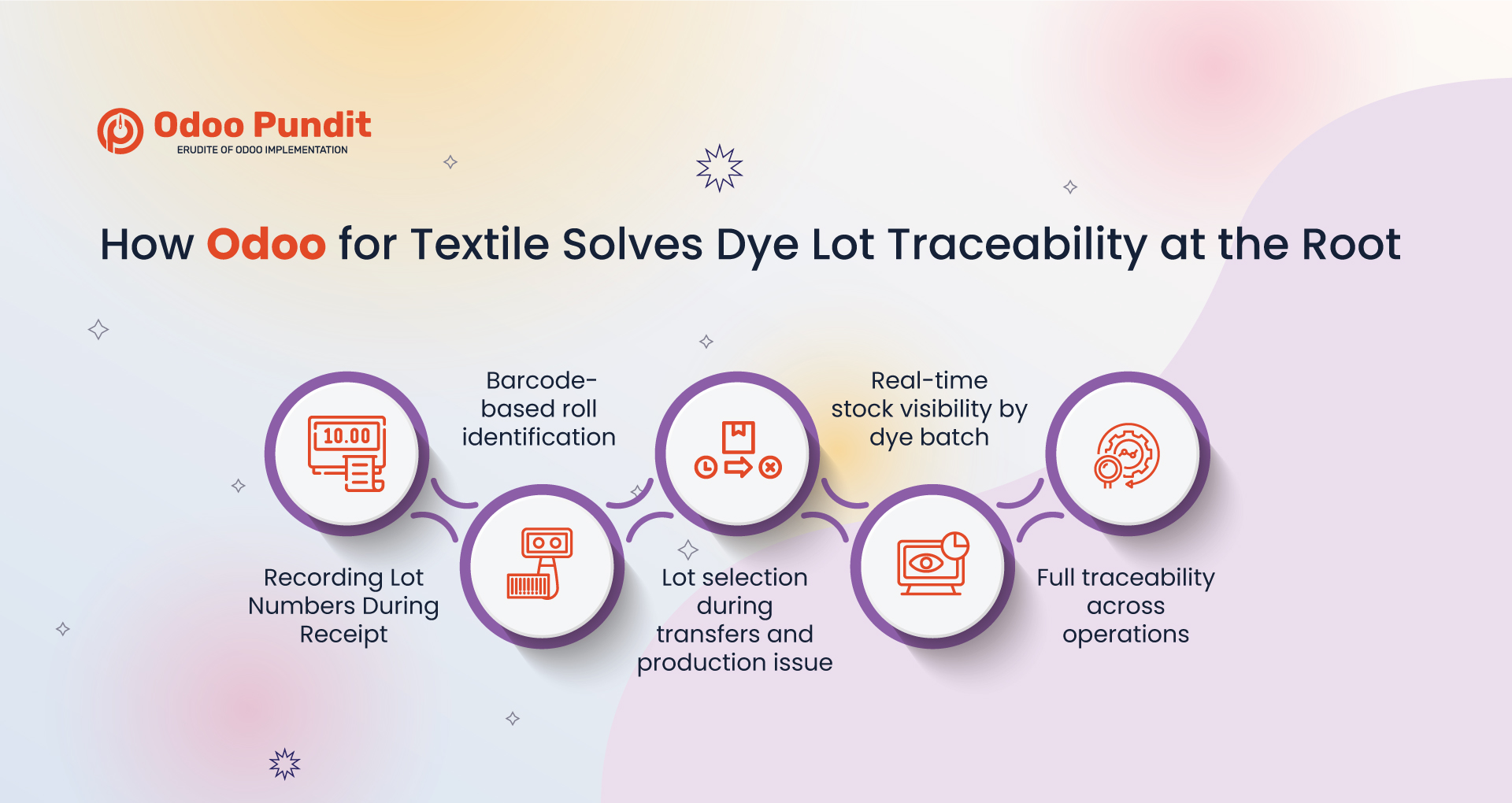
How Odoo for Textile Solves Dye Lot Traceability at the Root
Odoo provides practical tools for barcode fabric roll tracking and dye lot traceability.
Recording Lot Numbers During Receipt
When a product is set as Tracked by Lots, Odoo provides the option to record lot numbers on the receipt move lines. In practice, teams use Detailed Operations or the Barcode app, so each roll is scanned and its lot is recorded before validation.
Barcode-based roll identification
Odoo allows barcodes to be assigned to lot numbers. Businesses configure label formats and printers so rolls can be scanned instead of manually identified.
Lot selection during transfers and production issue
Odoo records the lot when operators select or scan it in Detailed Operations or through the Barcode app during transfers and production issues.
Real-time stock visibility by dye batch
The Lots/Serial Numbers report shows stock per lot at any moment. This is visible from Inventory → Reporting → Lots/Serial Numbers.
Full traceability across operations
Odoo’s Traceability report allows you to click a lot and see every receipt, transfer, production consumption, and delivery linked to that batch.
This is where many businesses explore a structured Odoo implementation to achieve reliable inventory traceability in Odoo.
Step-by-Step Textile Workflow Inside Odoo
Consider the same fabric with three dye batches from a vendor.
At receipt
Each roll’s lot is recorded on the receipt move lines using scanning or detailed operations.
At storage
With multi-location warehouses and putaway practices, Odoo records stock by location along with its lot number as teams place rolls into racks or zones.
At issue to production
The operator scans the roll, and Odoo records the lot consumed on the stock moves linked to the production order.
At finished goods
You can trace the stock moves of a finished product back to the exact dye lot consumed during production.
Many textile businesses also use Owner/Consignee tracking when handling buyer-supplied fabric, allowing the same fabric item to be tracked separately by customer lots.
How Does Odoo Handle Multiple Fabric Rolls Inside One Dye Lot?
In textiles, one dye lot contains many rolls with different meter lengths.
Odoo tracks quantity at the lot level by default. To manage roll-level detail, businesses use:
- Serial tracking for each roll
- Packages to represent rolls within a lot
- Barcode entries to record roll lengths during operations
By default, Odoo does not inherently know the meter length of each individual roll unless that information is captured during stock operations using serial numbers, packages, or barcode entries.
Some businesses rely on Odoo customization services to design roll-level barcode flows that match warehouse practice.
What Changes After Adopting Odoo for Textile Inventory?
- Less dependence on memory or registers
- Faster audits with clear lot reports
- Confidence during buyer inspections
- Reduced picking mistakes that cause shade variation
- Clear accountability without blame
Odoo does not detect color differences. It prevents operational picking errors through lot discipline.
From Chaos to Control
Fabric shade difference issues, dye lot mix ups, and traceability gaps are signs that the warehouse depends too much on people and too little on the system.
When lot identity becomes part of daily operations through scanning, locations, and disciplined workflows, confusion drops sharply.
If this sounds familiar, review how your current process handles dye batches and how Odoo for textile workflows can make it reliable without adding complexity.
Not sure how your warehouse is handing dye lots today?
Let us show you how Odoo can make lot traceability foolproof in your textile inventory.
FAQs
A dye lot is a batch of fabric dyed together. Even identical colors can vary slightly across lots.
Because rolls look similar and systems don’t record lot selection during stock movements.
It ensures shade consistency and audit traceability.
Yes, by recording each dye batch as a separate lot.
It supports barcode labels, but printers and formats must be configured.
Lot tracking groups multiple rolls under one batch; serial tracking identifies each roll uniquely.