Manufacturing supply chains operate under constant pressure. Demand shifts, supplier lead times fluctuate, and inventory decisions directly impact cash flow and delivery performance. Manufacturers evaluating Odoo often ask a practical question: can it genuinely support supply chain planning, or is it simply a transactional ERP?
Most manufacturers already capture this data inside their ERP. The real challenge is turning operational information into clear, timely decisions before issues escalate.
This is where Supply Chain Intelligence in Odoo becomes relevant. Odoo is not a standalone predictive analytics platform. Instead, it connects planning, inventory, purchasing, and production data into a single operational view—helping teams understand current conditions, anticipate risks, and act earlier with confidence.
In short
Supply chain intelligence in Odoo is built on real-time ERP data, rule-based planning, and shared visibility across inventory, procurement, and manufacturing. It helps manufacturers anticipate issues using committed data and timing—not black-box predictions.
What Supply Chain Intelligence Means in a Manufacturing Context
In manufacturing environments, supply chain intelligence is less about advanced algorithms and more about shared operational clarity.
It means being able to:
- See accurate inventory positions across locations
- Anticipate shortages based on real demand and lead times
- Understand how supplier delays affect production schedules
- Identify bottlenecks before delivery commitments are at risk
Traditional ERP reports usually explain what already happened. Supply chain intelligence helps teams understand what is likely to happen next, based on current commitments, planning rules, and operational timing.
In real manufacturing deployments, this clarity often matters more than theoretical forecasting accuracy.
From ERP Data to Operational Insight
Manufacturers already generate large volumes of ERP data: sales orders, purchase orders, stock movements, production orders, and delivery schedules. The challenge is not data collection—it is interpretation.
Without integrated intelligence:
- Planning teams rely on static reports
- Data is exported into spreadsheets for reconciliation
- Decisions depend heavily on individual experience
Odoo’s unified data model keeps these signals connected. Sales, inventory, procurement, and production all operate on the same dataset. This reduces manual interpretation and enables planning discussions grounded in facts rather than assumptions.
This shared context is what allows intelligence to emerge naturally from daily workflows.
Why Traditional ERP Reporting Often Falls Short
Even modern ERP systems rely heavily on predefined reports. While useful, they often:
- Show information in isolation
- Require reconfiguration when business questions change
- Lag behind real operational conditions
Odoo’s advantage is not more reports—it is contextual visibility. When sales commitments, inventory movements, and manufacturing orders are linked, planners no longer need to reconcile separate views. Intelligence becomes part of execution, not an after-the-fact analysis exercise.
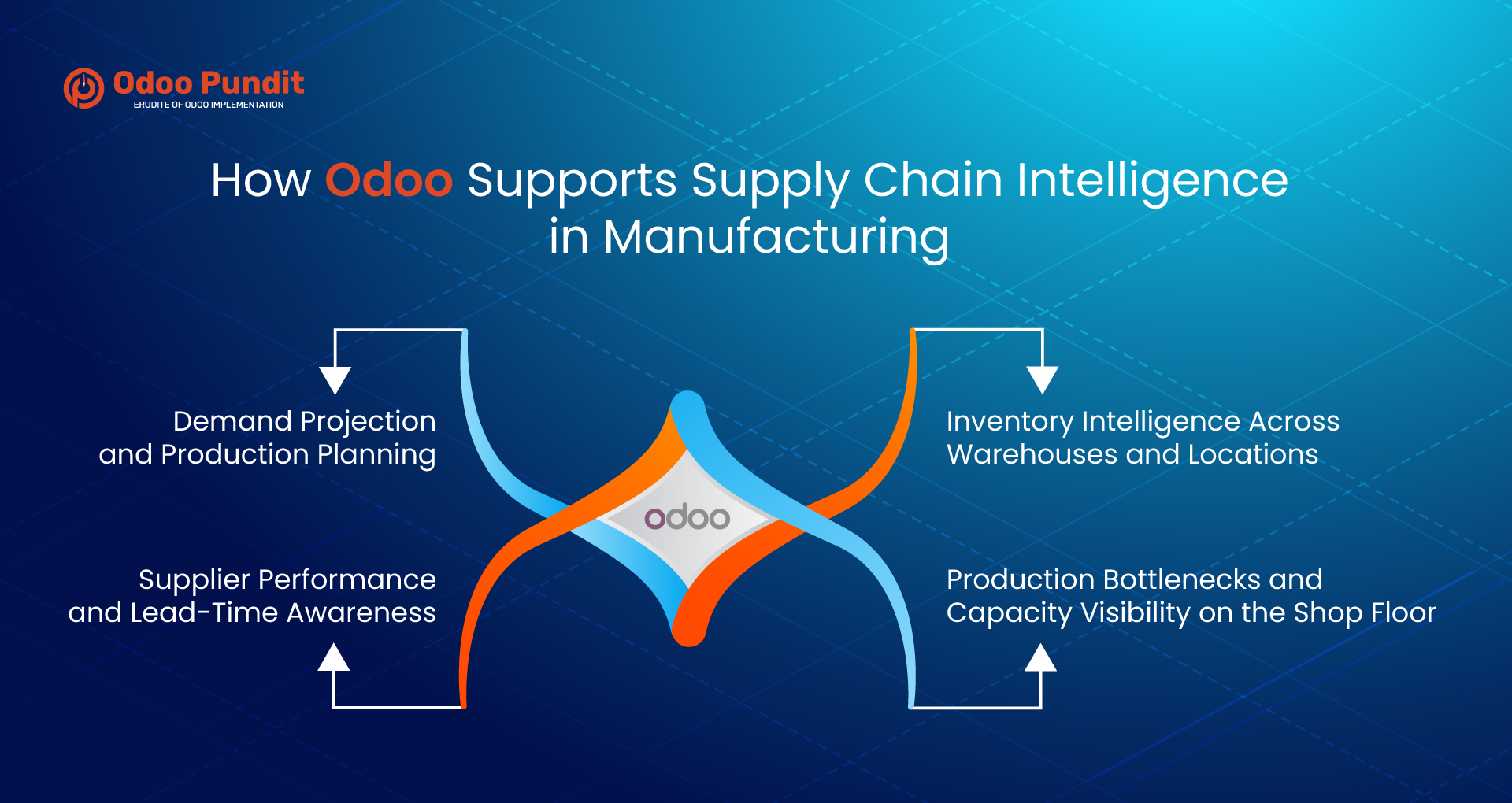
How Odoo Supports Supply Chain Intelligence in Manufacturing
Odoo enables supply chain intelligence through rule-based planning, real-time visibility, and integrated execution, not through fully autonomous AI forecasting engines.
This distinction is important for setting realistic expectations.
Demand Projection and Production Planning
Odoo’s demand projection is based on forecasted inventory views that calculate future stock levels using:
- Current on-hand inventory
- Incoming purchase and production orders
- Outgoing sales orders and manufacturing consumption
This allows planners to:
- Identify when shortages are likely to occur
- Align production with confirmed and expected demand
- Adjust schedules before issues escalate
Importantly, this forecasting is operational and deterministic. It relies on committed transactions and planning dates rather than machine-learning-driven demand prediction. Many manufacturers find this approach easier to trust because every projection can be traced back to real orders and timelines.
Inventory Intelligence Across Warehouses and Locations
Inventory is often where supply chain intelligence becomes visible first.
Odoo provides:
- Real-time stock levels across multiple warehouses
- Clear separation between available, reserved, and forecasted quantities
- Lot and serial tracking for full traceability
This visibility helps teams rebalance stock between locations, refine reorder points, and avoid urgent purchases driven by blind spots rather than genuine shortages.
As operations scale, this shared view becomes essential for maintaining control without adding overhead.
Supplier Performance and Lead-Time Awareness
Supplier reliability directly impacts production feasibility.
Odoo tracks supplier lead times directly within purchasing workflows, allowing teams to:
- Compare planned versus actual delivery dates
- Review purchase order history
- Identify recurring delays using standard reports
While Odoo does not include a full supplier scorecard system out of the box, the underlying purchasing data makes it possible to analyze vendor reliability through configured dashboards or reporting views. This keeps procurement decisions grounded in operational evidence rather than assumptions.
Production Bottlenecks and Capacity Visibility on the Shop Floor
On the shop floor, intelligence is about feasibility, not theory.
Odoo helps manufacturers:
- Monitor work center workloads
- Visualize production schedules
- Understand how delays in one operation affect downstream tasks
This allows planners to prioritize realistically instead of relying on static schedules that no longer reflect actual capacity or constraints. In practice, this visibility reduces last-minute rescheduling and improves delivery confidence.
Manufacturing Scenarios Where Odoo’s Intelligence Delivers Value
Make-to-Stock and Make-to-Order Operations
For make-to-stock manufacturers, Odoo helps balance service levels with inventory cost. For make-to-order businesses, it aligns purchasing and production with confirmed demand.
Hybrid strategies are also supported, allowing manufacturers to evolve their planning approach as complexity increases.
Multi-Warehouse and Multi-Plant Environments
As operations expand, visibility often declines.
Odoo helps teams:
- Compare stock positions across locations
- Transfer inventory instead of duplicating purchases
- Coordinate production planning across sites
This cross-site visibility directly supports procurement and production decisions.
Seasonal or Variable Demand Patterns
Manufacturers facing demand swings benefit from reviewing forecasted inventory alongside historical consumption—without relying on disconnected spreadsheets. Odoo’s integrated views reduce reconciliation effort and improve planning confidence.
What Supply Chain Intelligence Odoo Provides Natively (and What It Doesn’t)
Understanding the boundary between native functionality and advanced analytics is critical.
What Odoo Handles Well Natively
- Real-time operational visibility
- Rule-based replenishment and planning
- Demand-informed purchasing suggestions
- Integrated execution across inventory, purchasing, and manufacturing
For many small and mid-sized manufacturers, these capabilities alone deliver a significant improvement in planning discipline.
When Additional Analytics Are Considered
As complexity increases, some organizations extend Odoo with:
- Advanced forecasting logic
- Executive-level analytics
- Cross-system reporting
In these scenarios, Odoo remains the system of record, while intelligence is enhanced through configuration, BI tools, or partner extensions.
The Role of AI in Odoo’s Supply Chain Intelligence
As expectations around AI in ERP systems grow, it is important to separate reality from marketing noise.
Advanced AI-based forecasting and interpretation layers are most commonly introduced through partner solutions or specialized extensions. At its core, Odoo focuses on deterministic ERP logic—using real-time transactional data, structured workflows, and defined business rules to ensure accuracy, auditability, and governance.
Emerging AI capabilities can act as an interpretive layer on top of this foundation. Rather than executing decisions, AI can help users summarize data, explore trends, and understand exceptions more quickly.
In this model:
- Odoo remains the system of record
- Business rules and approvals remain unchanged
- AI supports understanding, not automation without control
This approach aligns well with manufacturing environments where traceability and accountability are non-negotiable.
Who Should Use Odoo for Supply Chain Intelligence
Odoo is particularly well suited for:
- Small and mid-sized manufacturers
- Companies adding operational complexity
- Teams seeking visibility without heavy IT overhead
As processes mature, organizations often extend Odoo through configuration or targeted Odoo customization services to better reflect real-world workflows.
Getting Started the Right Way
Supply chain intelligence depends as much on process discipline as technology.
Key success factors include:
- Accurate master data
- Clear ownership of planning decisions
- Alignment between sales, procurement, and production
Working with experienced partners who understand manufacturing operations—not just software—helps ensure Odoo supports better decisions. This is where structured Odoo implementation services add real value.
Key Benefits Manufacturers See Over Time
When used consistently, manufacturers often experience:
- Fewer stockouts and urgent purchases
- More stable production schedules
- Better collaboration across teams
- Greater confidence in planning decisions
The biggest shift is moving from reactive firefighting to informed anticipation.
Final Thoughts
Supply chain challenges are not disappearing. What separates resilient manufacturers from reactive ones is their ability to understand what their data is telling them—and act early.
Supply Chain Intelligence in Odoo is not about turning ERP into a black-box prediction engine. It is about using Odoo’s integrated design to bring clarity to everyday decisions across inventory, purchasing, and production.
When approached thoughtfully, Odoo becomes more than an operational system. It becomes a reliable source of insight that supports control, confidence, and steady growth.
Want to see how Supply Chain Intelligence in Odoo can streamline your warehouse and fulfillment workflows?
Start by evaluating where inventory gaps, lead-time delays, and planning blind spots are actually coming from.
Frequently Asked Questions
It refers to Odoo’s ability to connect planning, inventory, purchasing, and manufacturing data to support clearer operational decisions.
Odoo provides demand projection through forecasted inventory views and historical consumption-based replenishment logic.
Yes for many small and mid-sized manufacturers. As complexity grows, Odoo can be extended through configuration or integrations.
Not always. In some cases, Odoo is sufficient on its own; in others, it complements specialized tools.